News, exhibitions and updates from the studio.
arTTable 2026 at The Arc, Winchester
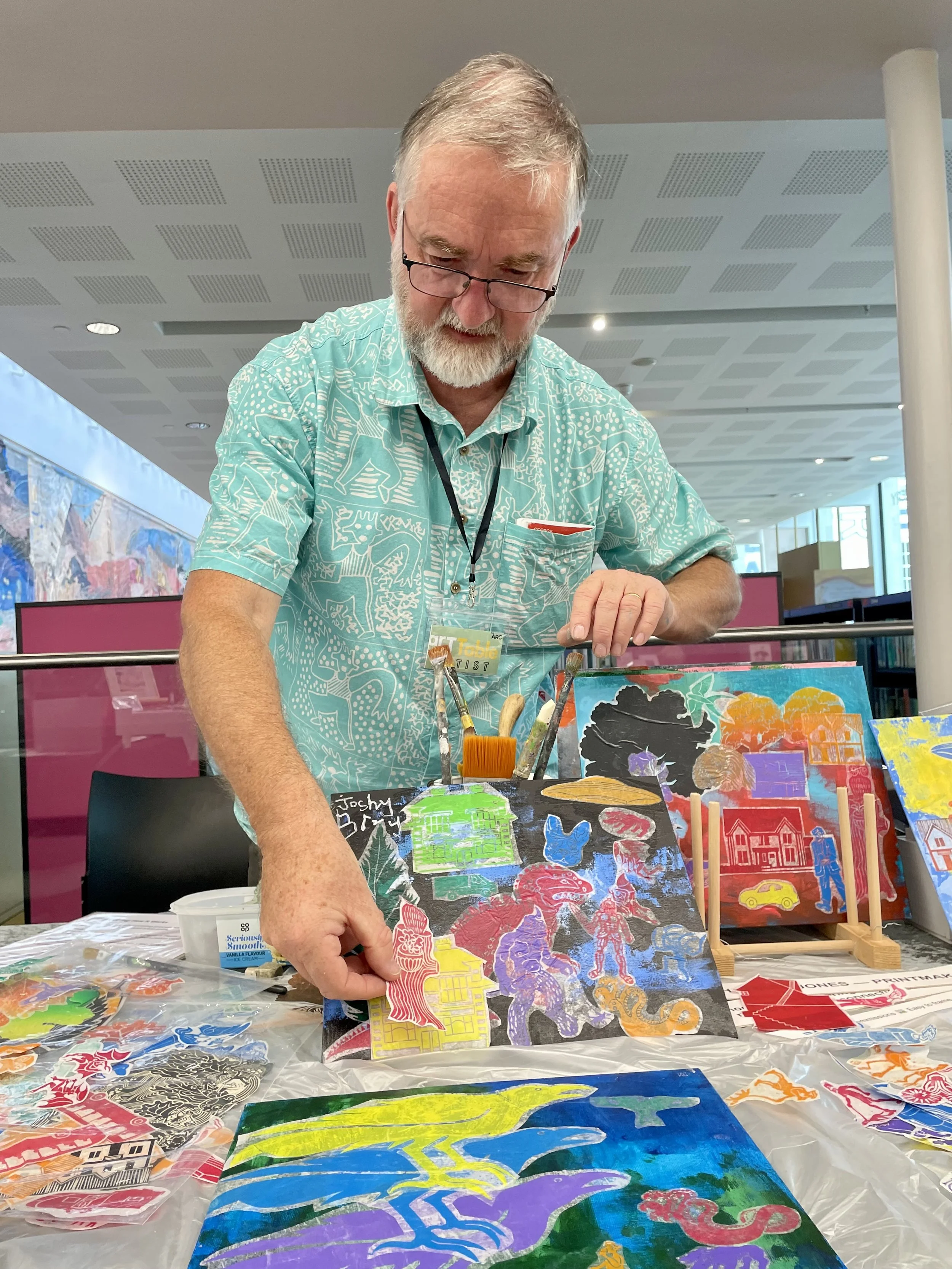
Mark demonstrating collage production technique at ArTTable, The Arc Winchester, Oct 2026. Photograph Sue Jones
arTTable 2026 at The Arc, Winchester
On Saturday 3 October I took part in arTTable 2026 at The Arc, Winchester, demonstrating linocut and sharing some of the processes behind my original prints.
I brought sketchbooks, works in progress, finished prints and the tools I use in the studio. It was a chance to show how ideas develop from walking, observation and memory into finished work, and to talk to visitors about the techniques and decisions involved in making a hand-printed image.
My three Harryhausen-inspired works were also on display nearby as part of Harryhausen Is My Hero at The Arc.
Thank you to everyone who came along, stopped to look, asked questions or talked to me about printmaking.
Harryhausen Is My Hero
My three works remain on display at The Arc as part of Harryhausen Is My Hero, running until 22 November 2026.
Harryhausen Is My Hero — The Arc Winchester
Why Harryhausen is my hero
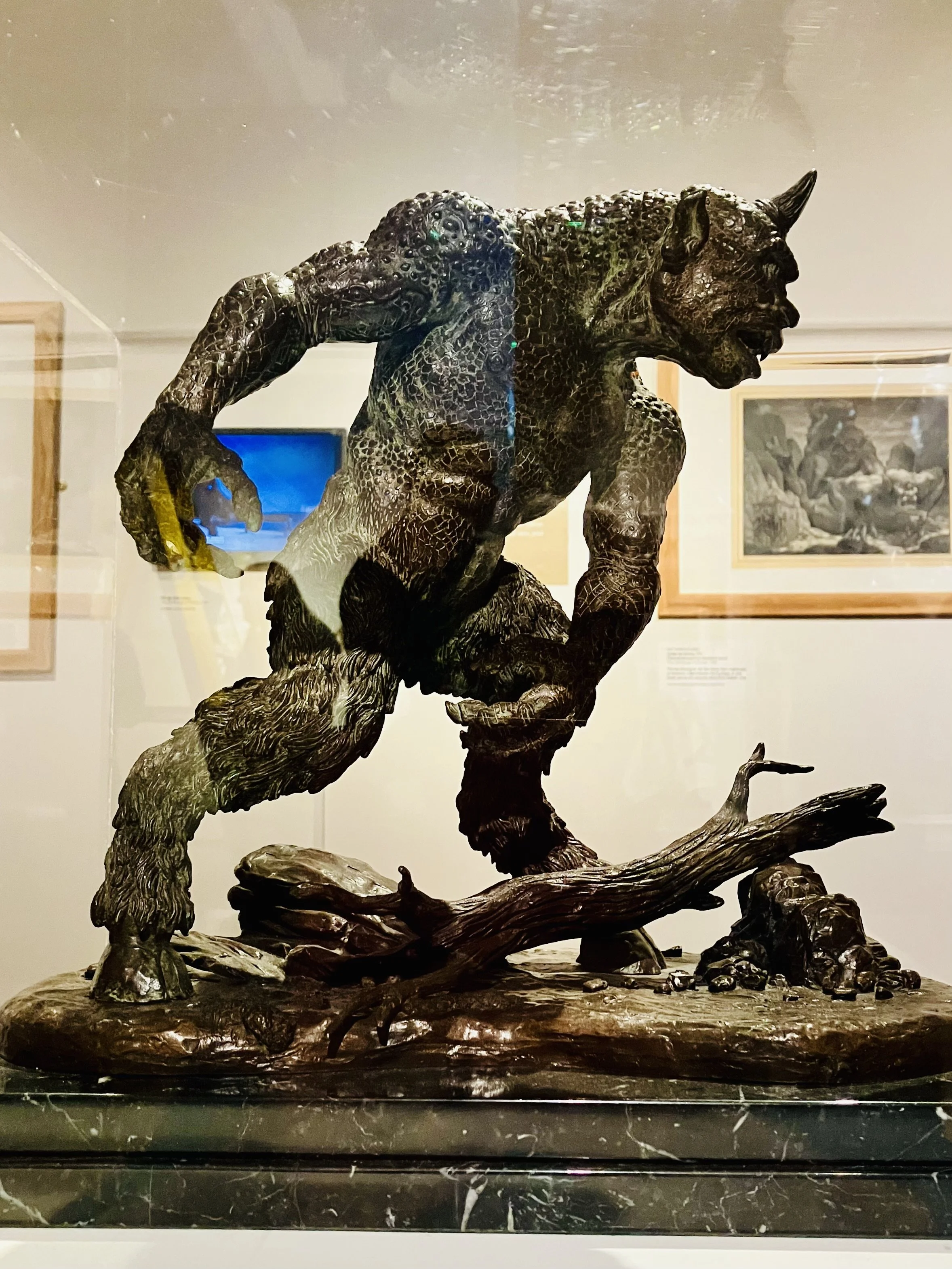
Cyclops. Bronze H 30 cm approx. Ray Harryhausen. On display at the Ray Harryhausen Myths in Motion Exhibition The Arc, Winchester. Photography Mark Jones
The unexpected moment
Yesterday I went to The Arc Winchester for the press opening of Harryhausen Is My Hero, an exhibition celebrating the influence of Ray Harryhausen. I already had a particular reason for being there: three of my own artworks are included in the City Space exhibition.
What I hadn't expected was to meet Harryhausen's daughter, Vanessa, and to have her sign the book she wrote about her father and his extraordinary career

Vanessa Harryhausen at the press opening of Ray Harryhausen’s Myths in Motion, exhibition, the Arc Winchester. Photography Mark Jones
Why Harryhausen mattered to me.
The combination of fantastical creatures moving through strange and exotic landscapes creating imagined worlds. Combined with Harryhausen’s lively and evocative concept sketches, which tell stories through dramatic images and give the feeling that the impossible could be made tangible, this approach showcases a highly skilled and versatile artist passionate about the subject matter. It’s inspirational.
From Harryhausen to my own artwork

The Geography of Imagination 84 x 59 cm Mixed media on canvas. Photography Mark Jones
Although my own work is very different from Harryhausen's, I think there is a connection in the way we both use familiar visual elements to construct imagined worlds. His creatures transformed drawings and models into characters with a sense of life and personality. In my own work I have become increasingly interested in transforming the familiar landscape around me into something more mysterious and imaginative.

Good Morning Mrs Jones, Linocut 10 x 21 cm Mark Jones 2026
It strikes me that, in the recent film The Odyssey 2026, Cyclops tenderly tended his flock of sheep, so perhaps he would take his sheepdog for a daily walk when off duty? In this linocut print they have wandered into the suburbs and met my wife walking our dog Bruce.

You said this was a shortcut, Linocut 15 x 15 cm Mark Jones 2026
The Harpies from Jason and the Argonauts steal from Phineus, who was a blind, aging Thracian king. In my linocut print, they are harassing a couple of joggers with their dog in the local woods.
The Vanessa Harryhausen moment
The most memorable part of the afternoon was meeting Vanessa Harryhausen. She has written about her father's life and work, and I was fortunate enough to have my copy signed by her. It was a rather extraordinary moment: to stand in an exhibition inspired by Ray Harryhausen, with three of my own works on the City Space wall nearby and then meet someone who knew the artist behind the films that had inspired so many of us.
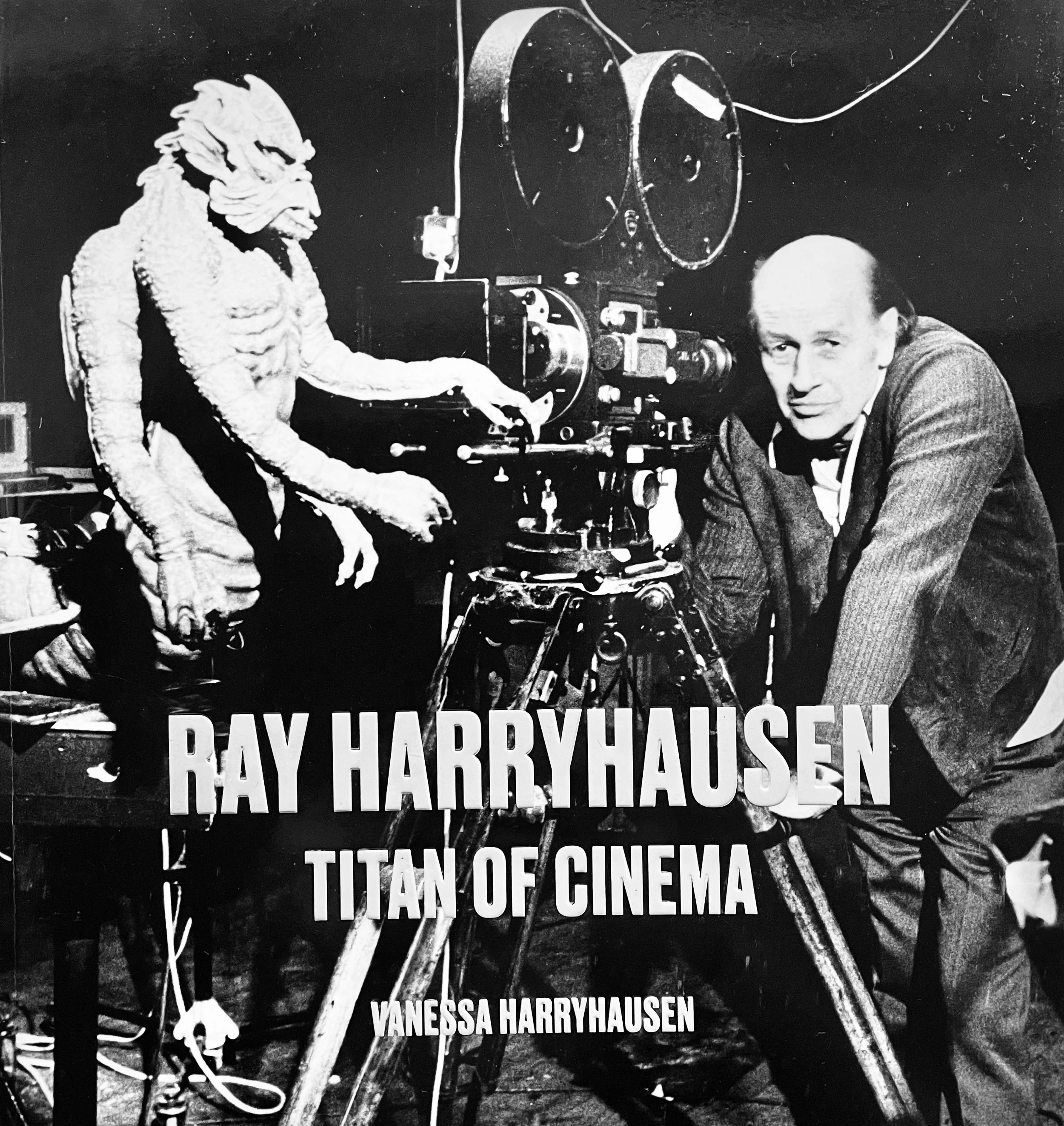
My signed copy of Vanessa’s book about her father’s work. Photograph Mark Jones
The exhibition
Video showing the press open day at the Ray Harryhausen: Myths in Motion at The Arc Winchester
Harryhausen Is My Hero runs at City Space at The Arc Winchester until 22 November 2026. It is a free exhibition that brings together artists, makers, animators, and enthusiasts inspired by Harryhausen's films and imagination.
Alongside it, Ray Harryhausen: Myths in Motion explores his work and legacy in The Gallery from 26 September 2026 to 16 February 2027.
Come and see the exhibition →
Community Art in Hampshire: The Boorley Green Frieze Unveiled
Opening
Yesterday marked the completion of almost a year's work...
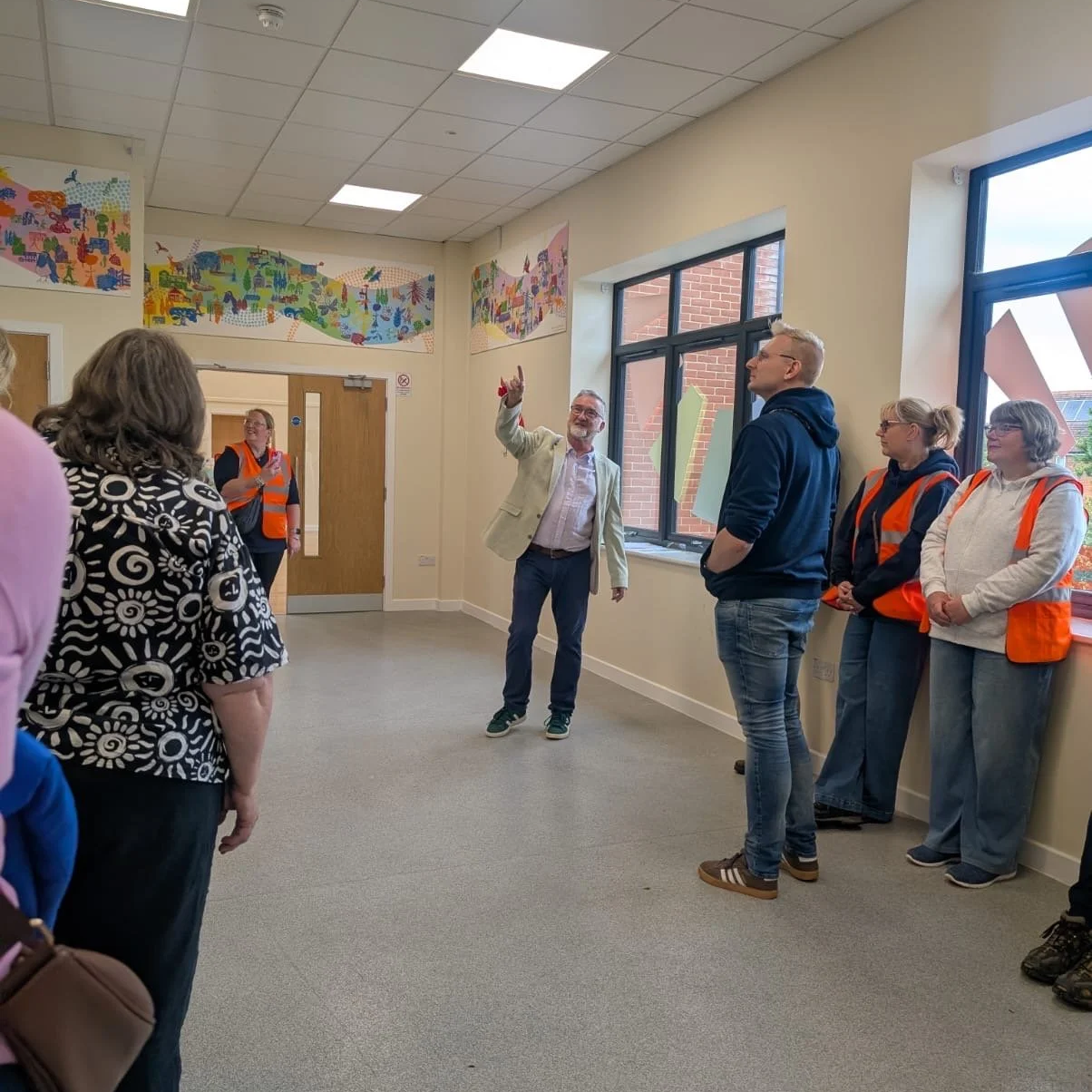
Mark Jones giving a speech at Boorley Green public art launch 7 June 2026 Photograph Jo Morley
The Unveiling
The unveiling ceremony, officiated by Richard Gomer, had a relaxed and informal atmosphere. Friends, neighbours, and members of the local community gathered to explore the artwork, enjoying the opportunity to discover its details and recognise their own contributions within it.
Origins
A year ago, I met with Vicky Fear and Kathryn Grimes and Matthew Wanstall to discuss the creation of a celebratory public artwork that would be developed in collaboration with local community groups.
From the outset, Botley Parish Council was enthusiastic about the idea of the piece taking the form of an alternative map of Botley and Boorley Green—one that would celebrate the area's natural landscape, local wildlife, and the many ways people connect with and enjoy the outdoors.
Workshops
Sue and I collaborated with local residents on linocut workshops, including with Botley and Boorley Green WI, Premier Education HAF holiday camp, the local home school community, and visitors to the Revels on the Rec 2025. The brief stipulated that the project should involve local people, valuing local talent and perspectives, and nurturing artistic growth through creativity and innovation.
Memory Map
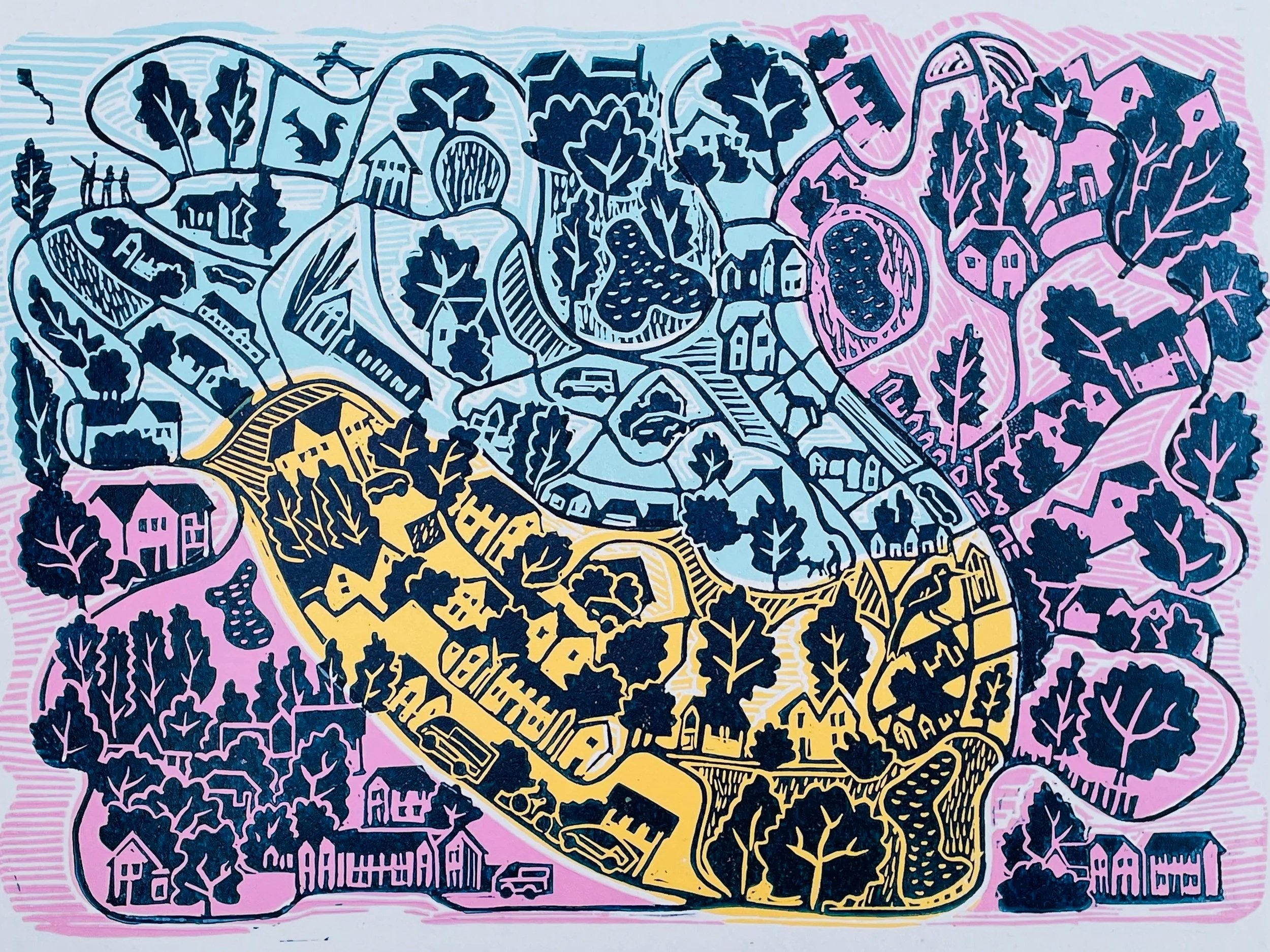
Memory Map colour linocut print 15 × 21 cm 2026 photograph Mark Jones
To commemorate the unveiling, I created Memory Map, a limited edition linocut print of fifteen. Designed as a lasting memento of the project, it allowed participants to take away a physical reminder of the day and the collective journey behind it. The edition will also be available to purchase through my website.
Along Our Way

Along Our Way Boorley Green Community Frieze (Prototype edition) June 2026 Photograph Mark Jones
BOORLEY GREEN COMMUNITY FRIEZE (PROTOTYPE EDITION)
Mixed Media Painting & Print on Panel
Approx. 10 metres in length
Price: £6,700
Concept
The frieze explores ideas of place, familiarity, and collective identity. It translates everyday experiences—paths walked, spaces shared, and local textures—into a layered visual language.
Rather than presenting a single narrative, the work holds multiple perspectives, reflecting the diversity of voices that contributed to its development.
Key Features
Scale: Approx. 10 metres (modular if required)
Medium: Mixed media (paint + print-based processes)
Format: Suitable for long wall display in public or civic spaces
Origin: Developed through community engagement workshops
Suitable For
Schools and academies
Libraries and civic buildings
Council and community spaces
Cultural and arts organisations
The work is particularly suited to environments that value community engagement, place-making, and accessible contemporary art.
Enquiries
For further information, images, or to arrange a viewing:
Mark Jones
markhowardjonesart@gmail.com
07397166978
This prototype is seeking a permanent home.
Reflection
Public art is not simply about making an object; it is about creating a space where people can recognise something of themselves. Sue and I approached this project by letting it grow organically, shaped by the people and places around it. The journey has been marked by many memorable moments—from leading workshops and sharing the excitement of experimental printmaking to the invaluable encouragement and support we have received from businesses and institutions
Quotes
‘Congratulations to Mark, Sue, and everyone in Botley and Boorley Green! What a fabulous achievement - you’ve come together to make something beautiful that represents the community - the people, the buildings, the wildlife …. and the pets!’ Vickie Fear EBC
‘It’s been an honour to work on the project with you - Thank you for bringing my crazy vision to life’ Kat Grimes Communications Officer Botley Parish Council
The frieze now belongs to the community that helped create it.
From Mapping the Familiar to Boorley Green: A Collaborative Artwork

Boorley Green Community Centre public art frieze close up. Photograph by Mark Jones
Following my recent exhibition Mapping the Familiar at The Arc, Winchester, I’ve been developing a new body of work that extends those ideas into a shared, public context.
At Boorley Green Community Centre, this has taken the form of a collaborative frieze created with local residents. Rather than working from observation alone, this project has been shaped through conversation—through the everyday experiences, memories, and details that define a place for the people who live there.

Boorley Green and Botley W.I. print workshop participants, Photography Mark Jones
Workshops and informal sessions became spaces for exchange: drawing, discussing, and reflecting on what feels familiar, what stands out, and what connects people to their surroundings. These contributions form the foundation of the final piece.
The resulting artwork is not a fixed narrative, but a layered one. It brings together multiple perspectives into a shared visual language that sits within the community it represents.
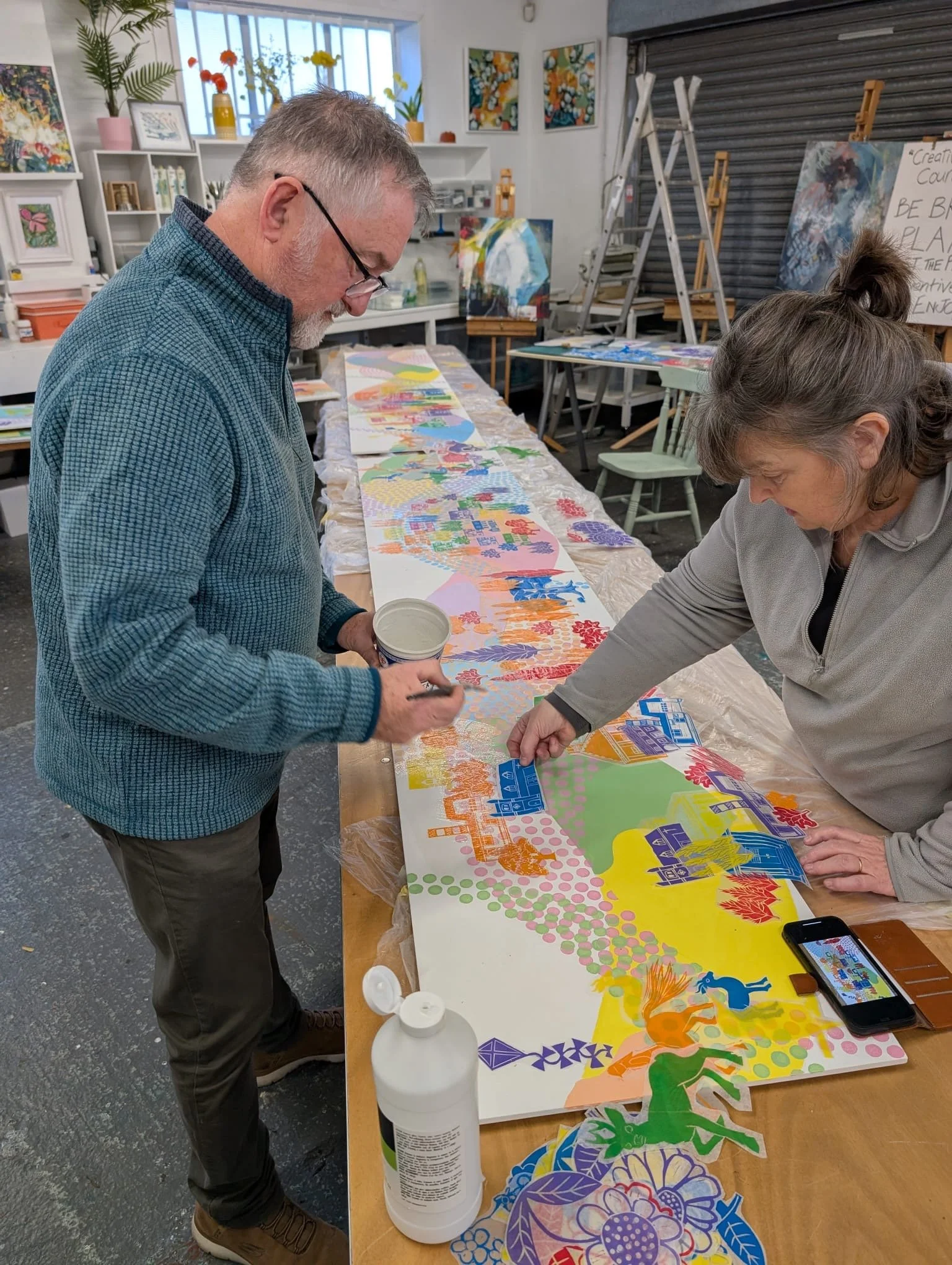
Mark + Sue Jones working on Boorley Green Public art Frieze at Jo Morley studio, Southampton. Photography Jo Morley
The frieze will be unveiled on Sunday 7 June 2026 at Boorley Green Community Centre 10.30 (Launch talk) - 4 pm
This moment is as much about the process as the outcome— a chance to gather, reflect, and celebrate what has been created collectively.
All are welcome to attend.

Exhibiting at Printfest: A Practical Guide from Setup to Takedown
Thinking of exhibiting at PrintFEST Ulverston? A first-hand guide covering setup, sales, and lessons learned from a UK printmaking fair.
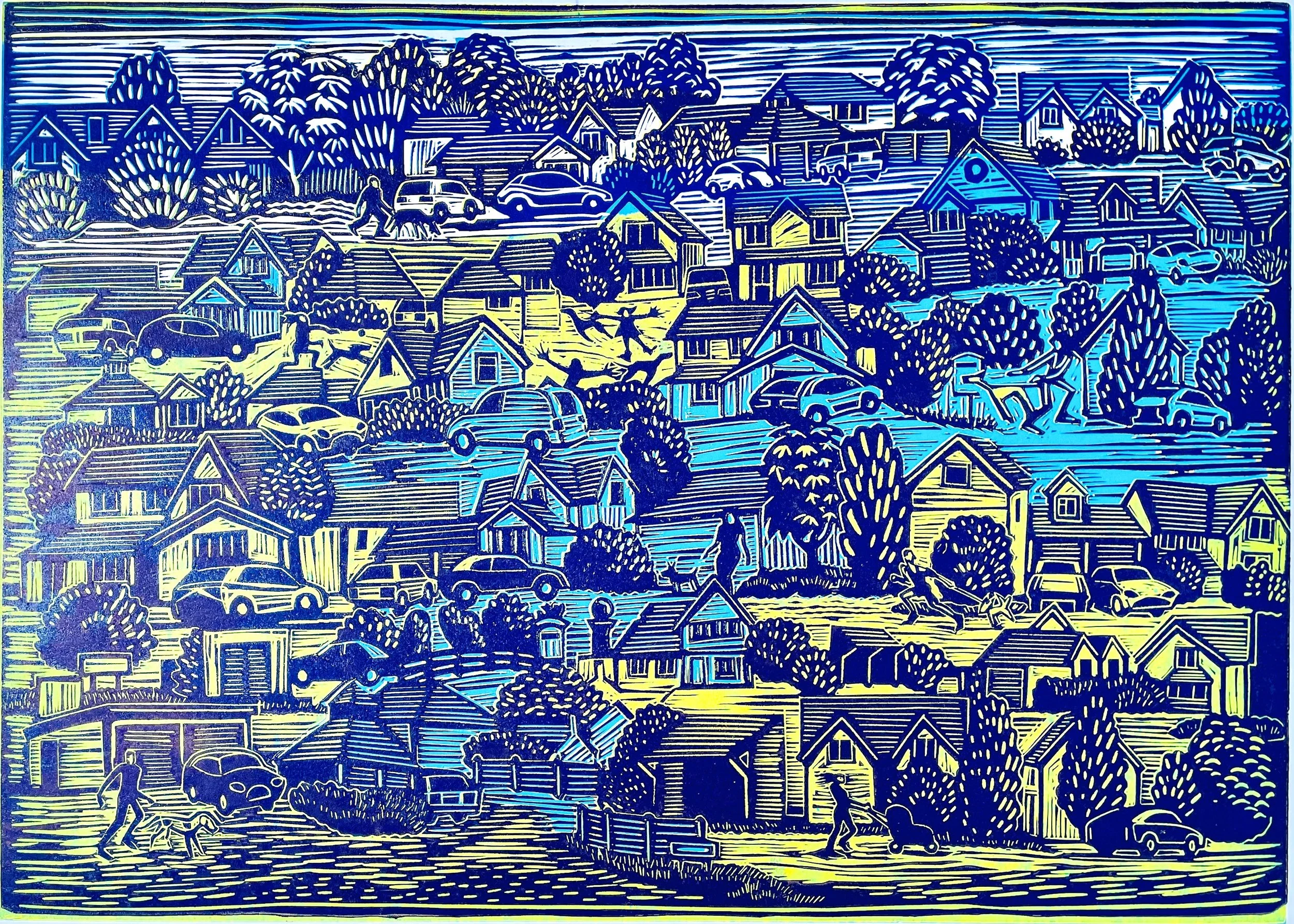
Morning Walk linocut detail. Photograph Mark Jones
Exhibiting at Printfest for the first time is both exciting and slightly daunting. After taking part, I can say it’s one of the most rewarding and instructive experiences I’ve had as a printmaker.
If you’re considering applying, this guide walks through the full experience—from preparation and setup through to sales, takedown, and what I’d do differently next time.
How to Prepare for Printfest as an Exhibitor
Preparation starts well before you arrive.
For me, that meant selecting a cohesive group of linocut prints from an ongoing body of work. Choosing what to show isn’t just about picking your strongest pieces—it’s about how they sit together and read as a whole.
Packing and transport are equally important. Prints, frames, fixings, tools—it adds up quickly, and everything needs to arrive intact and organised. One of the most useful things I did was plan my stand layout in advance, so I wasn’t making decisions on the spot.
Tip: Sketch your wall layout before you arrive. It saves time and reduces stress during setup.
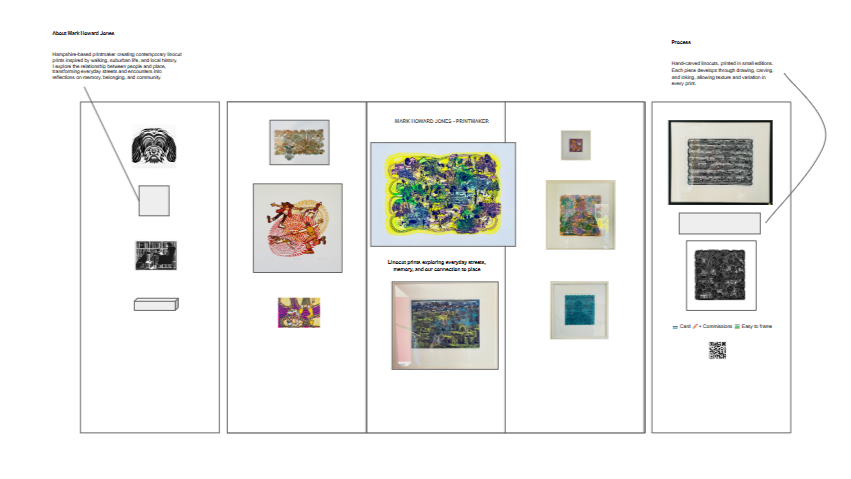
Screenshot of PrintFEST stand Plan. MarkJones png
Unloading and Setting Up Your PrintFEST Stand
The logistics on arrival were noticeably well organised. Unloading was calm, structured, and efficient - something that makes a real difference when you’re carrying a lot of work and equipment.
Because I had a clear visual plan, setting up felt straightforward. Rather than experimenting with placement, I could focus on getting the work up quickly and accurately.
That shift - from preparation to presentation - is a key moment. Seeing the prints on the wall, properly lit and spaced, changes how you view your own work.
What helps:
Arrive with a layout plan
Label your work clearly
Bring basic tools and backups
How to Display Prints at an Art Fair
A strong display does more than look good - it helps your work connect.
What worked for me was keeping things visually consistent and uncluttered. Giving each piece space allowed the detail of the linocuts to come through, while the overall arrangement created a rhythm across the stand.
One thing I’d refine further is how the work reads at a distance. At busy moments, visitors often scan before they engage—so clarity from a few steps back matters.
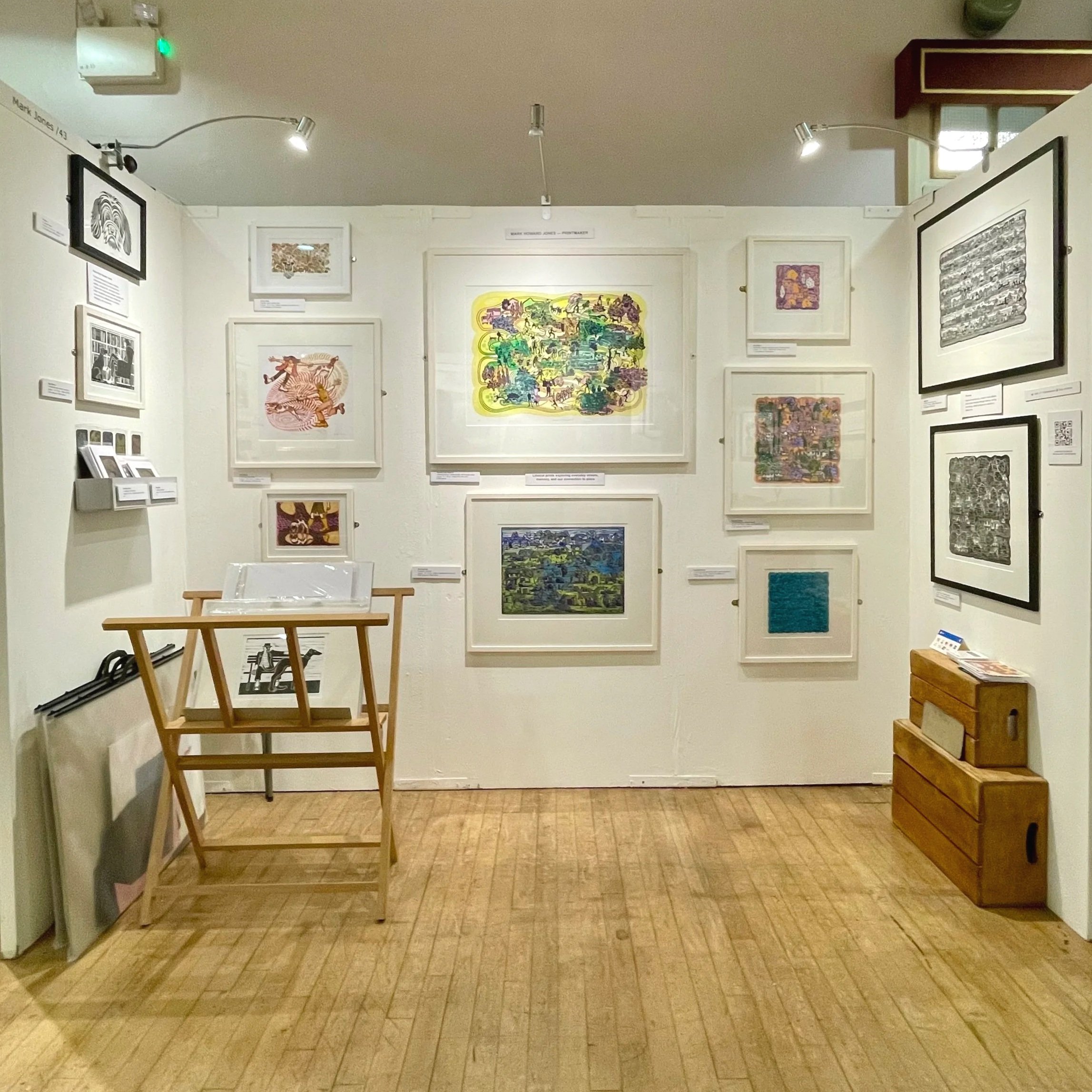
Mark Jones stand 43. Print Fest Ulverston 1 - 3 May 2026 photograph Mark Jones
Key considerations:
Can your work be understood from a distance?
Are prices easy to find?
Does the display guide the viewer naturally?
Talking to Visitors at Printfest
One of the defining aspects of Printfest is the audience.
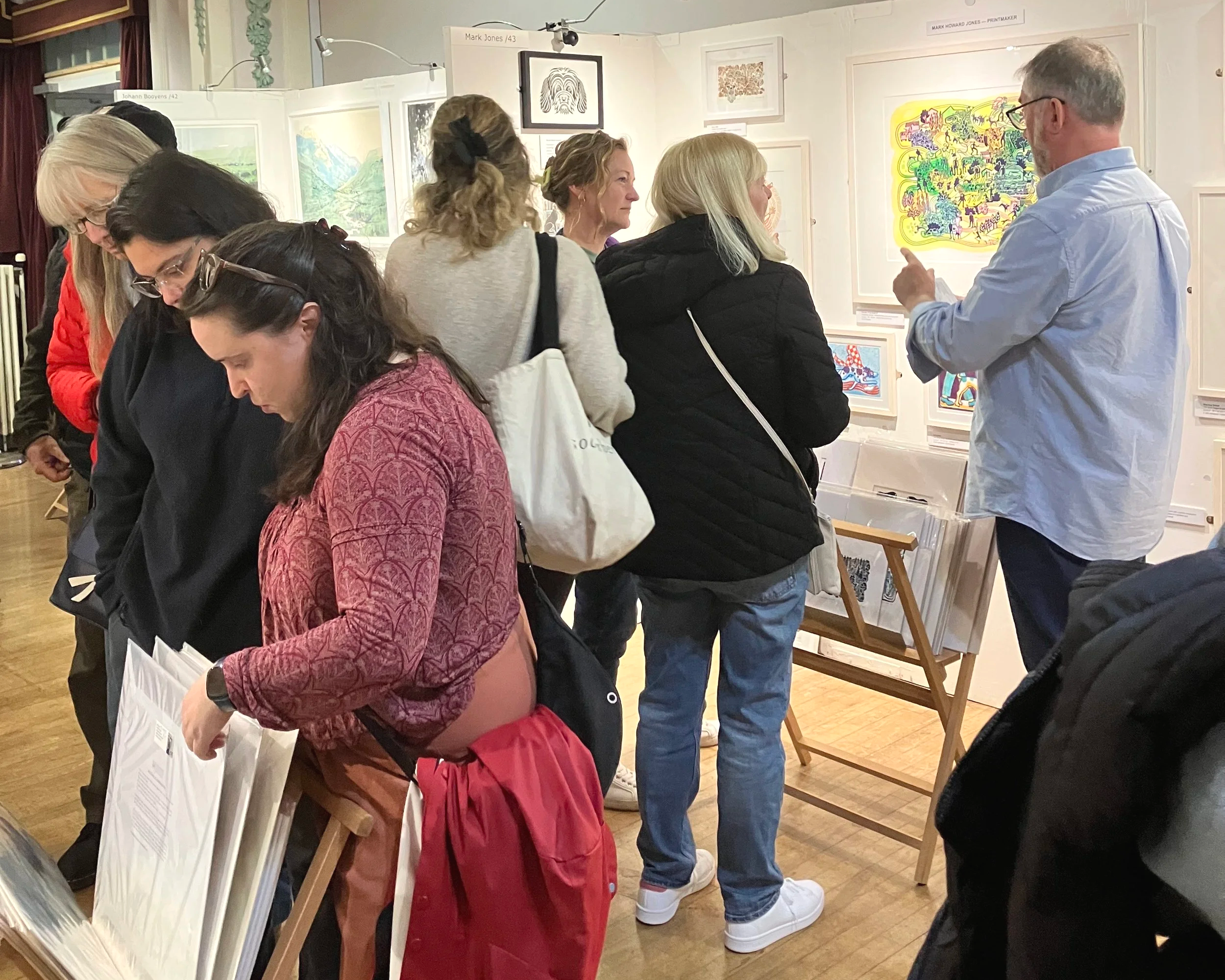
PrintFEST Ulverston, Mark talking with customers. Photograph Sue Jones
Visitors are often very knowledgeable about printmaking, which changes the nature of conversations. Rather than surface-level comments, people ask about process, technique, and decision-making.
Explaining how a linocut is made—carving, inking, printing—becomes part of the experience. Those conversations build connection, and that connection often leads to sales.
What works:
Be open and conversational
Talk about process, not just outcome
Let people look—don’t rush the interaction
Taking Payments at Printfest: What Worked
Sales always come with practical considerations.
At one key moment, our SumUp card reader stopped working. Not ideal - but switching to phone payments turned out to be quicker and simpler than expected.
It’s a good reminder that backup systems matter, but also that simple solutions are often more reliable than you think.
Lesson: Always have a fallback for payments - and keep it straightforward
The Quality of Printmaking at Printfest
The overall standard of work was exceptionally high.
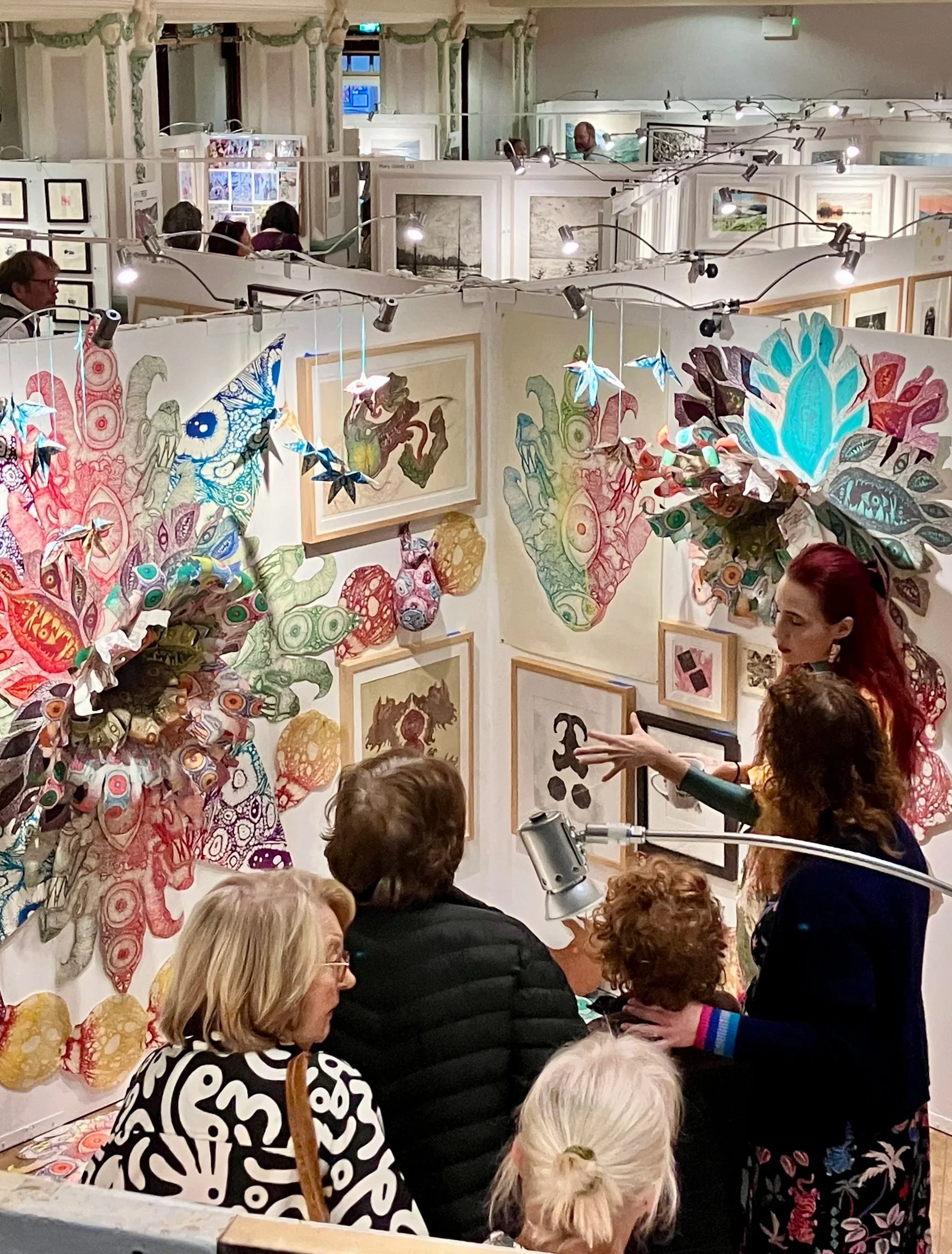
View from above of PrintFEST exhibitors and visitors. Stephanie Berry and her exhibition stand in the foreground.
Being surrounded by that level of printmaking is both inspiring and challenging. It raises your expectations—not just of your work, but of how you present it.
With 14 awards handed out over the weekend, there’s a clear sense of both quality and recognition. It’s a serious environment, but a supportive one too.
Packing Down After Printfest
The takedown was as efficient as the setup.
After an intense weekend, that matters. Everything moved quickly and smoothly, and before long the space was cleared.
It’s a strange moment - going from a fully realised display back to packed boxes - but it gives you time to reflect on what just happened.
What Worked Well at My First Printfest
Having a clear visual plan for the stand
Creating space for genuine conversations
Staying adaptable when things didn’t go to plan
What I’d Do Differently Next Time
Refine the display so work reads more clearly at a distance
Improve pricing visibility
Prepare more thoroughly for busy periods
Build in better backup systems (especially for sales)
Final Thoughts: Is Printfest Worth It?
For me, Printfest felt like a real step forward.
Not just in terms of sales, but in understanding how the work exists in a public space - how people engage with it, question it, and respond to it in real time.
If you’re a printmaker considering applying, it’s well worth it. Just go in prepared, stay flexible, and treat it as both an opportunity and a learning experience.
See Available Work
If you couldn’t attend Printfest, you can view available linocut prints here:
👉 www.markhowardjones.art
👉 Instagram: @mark.jones.art
Mapping the Familiar

Boorley Green Community Centre Frieze 3 of 4 Acrylic and ink on wood panel 75 × 2400 cm. Photograph Mark Jones
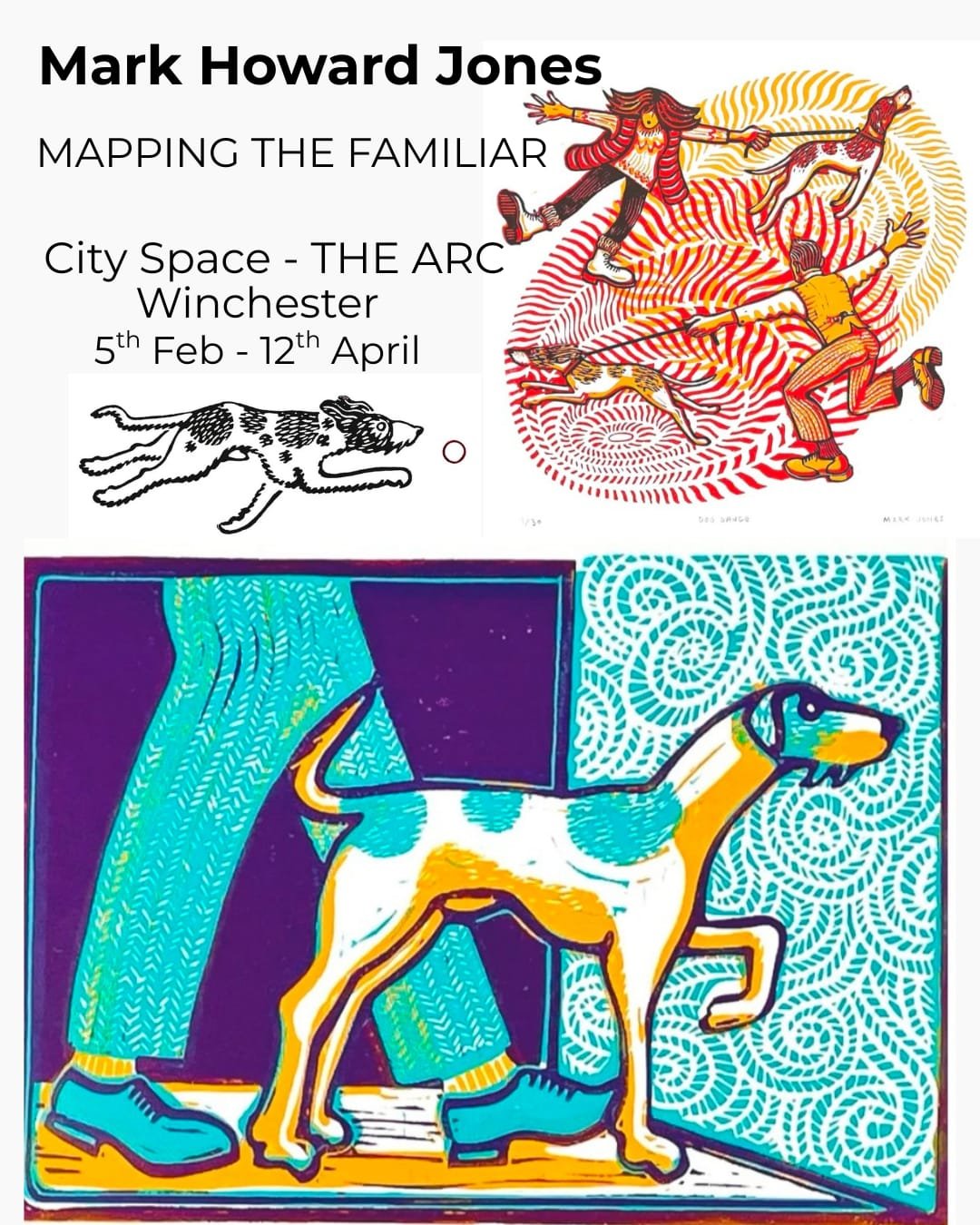
Mapping the Familiar online poster designed by Jo Morley Studio.
One of the best parts of spending time at an art exhibition is the conversations that spark up around the work. I love hearing how people connect to it - especially when they see things I never expected—yes, answering questions matters, but listening matters just as much. The feedback, the stories, the interpretations - they all deepen my own reflection.
Lately, I’ve been looking back at the work I’ve made over the five years since retiring from teaching art. When I installed it, chronology wasn’t the point. I wanted strong visual moments right at the entrance - something that would pull people in and draw them up to the mezzanine floor.
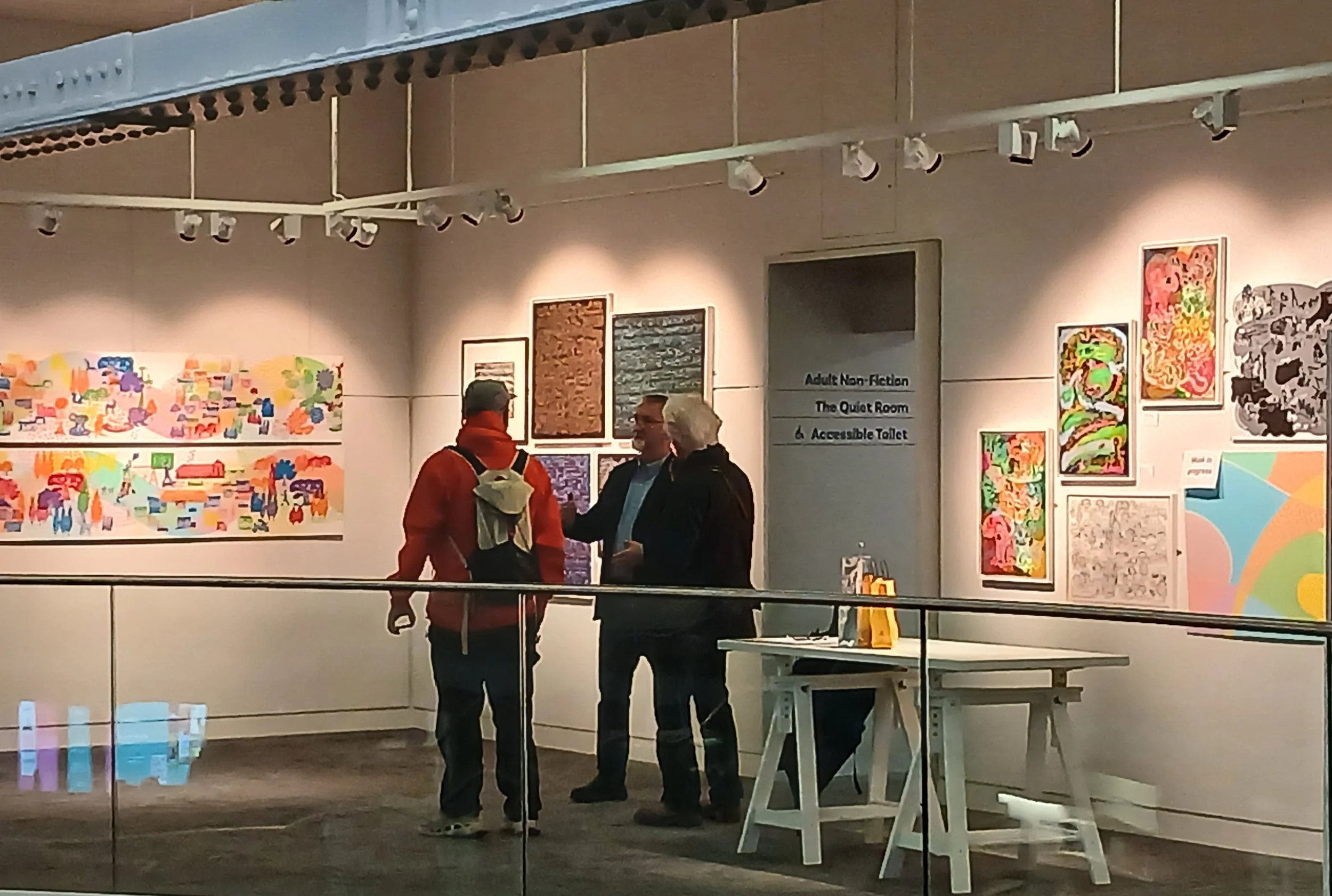
Dr Simon Hobbs, MJ, and David Thomas at Mapping the Familiar, The Arc, Winchester. Photograph Sue Jones
I’ll be doing demonstrations every Tuesday, Thursday and Saturday at The Arc, Winchester, until the exhibition finishes on 12th April.
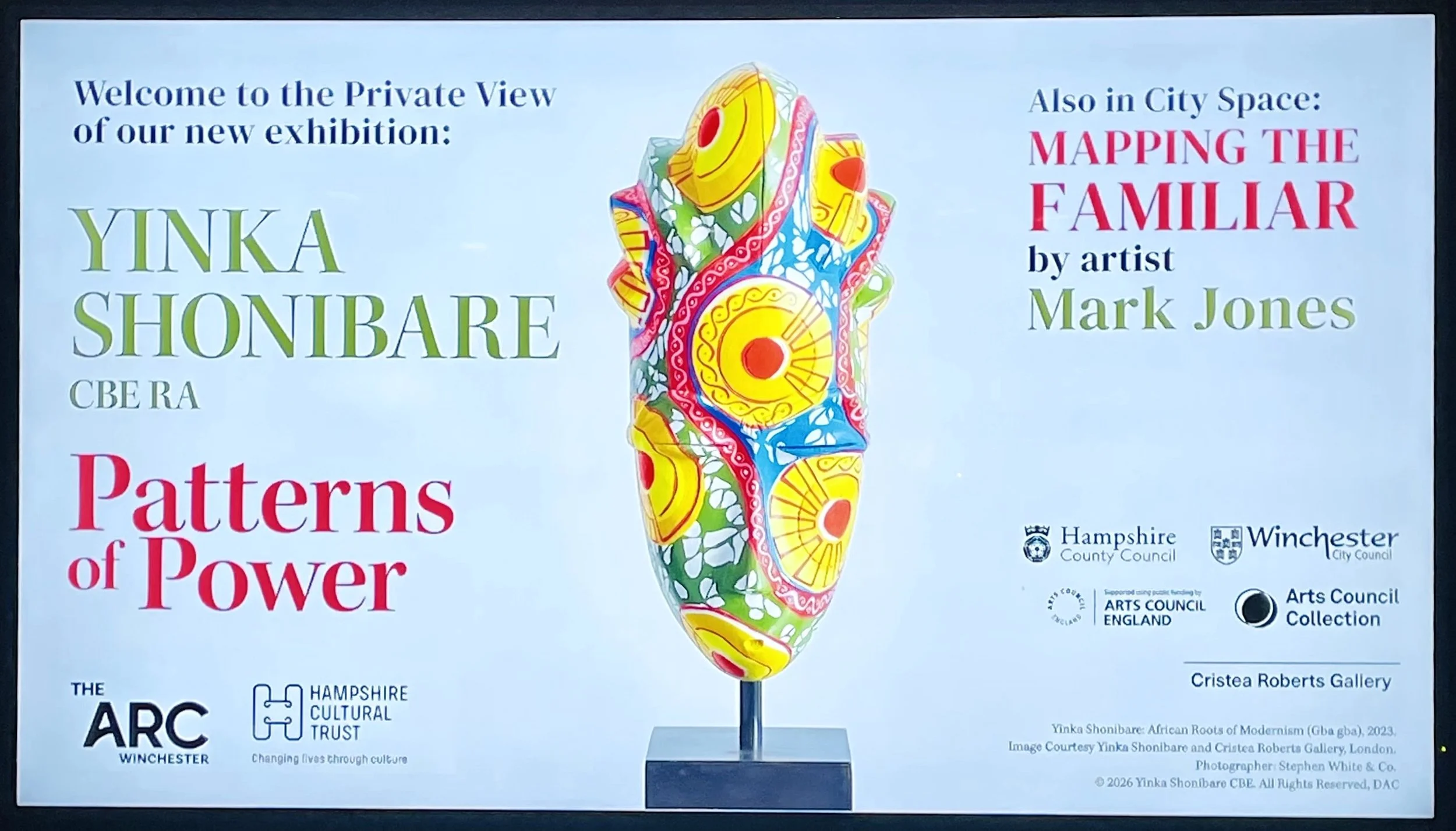
Promotion welcoming guests to the Yinka Shonibare Patterns of Power private view. Photograph Mark Jones
Mapping the Familiar
I’ve been thinking a lot about familiar places — the ones we move through every day without really noticing — and how they hold memory, routine and quiet significance. Mapping the Familiar grew out of that thinking.
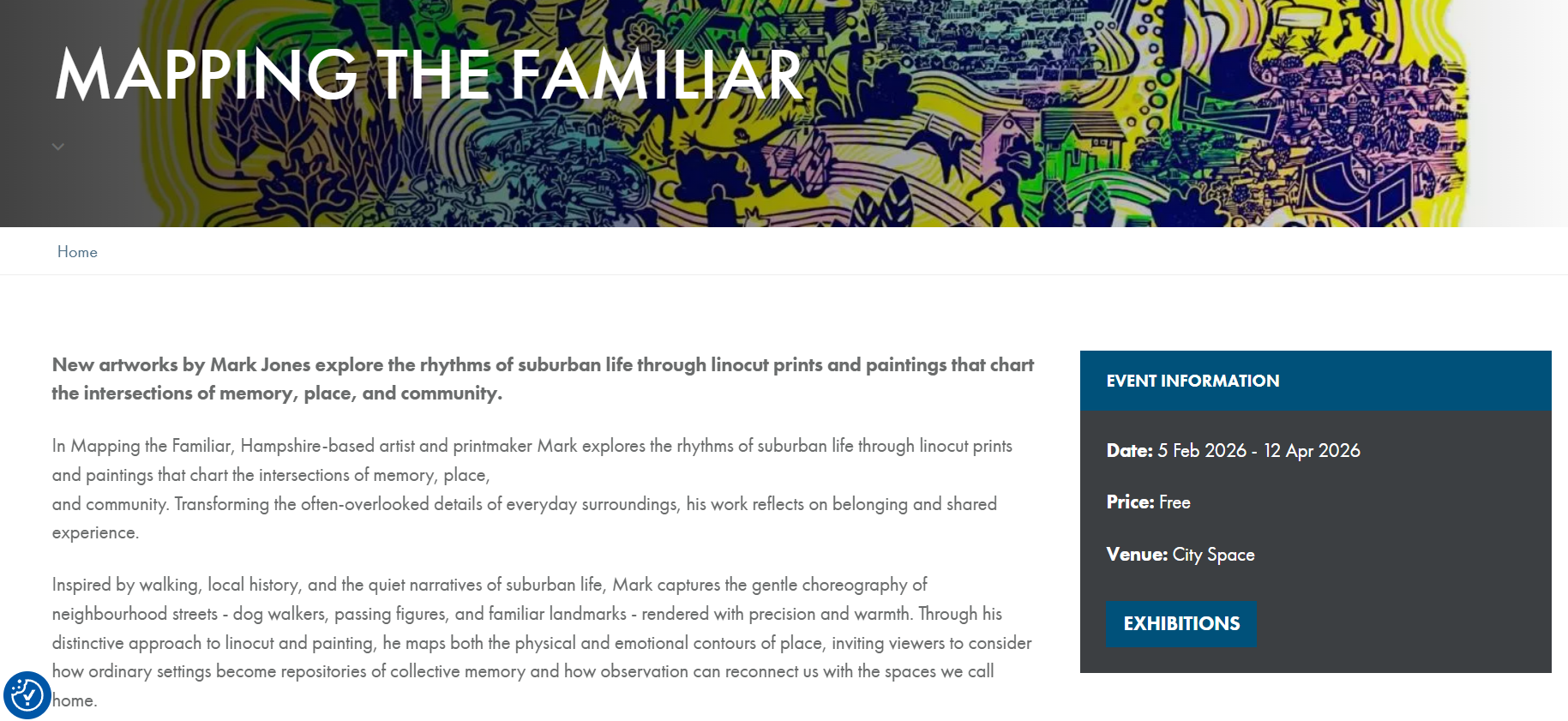
Screen shot from The Arc events website page

Hampshire Cultural Trust exhibition team, Kirsty Rodda, John Reid and Boris Allenou hanging Mapping the Familiar artwork. Photo Mark Jones
The exhibition brings together recent paintings and lino prints, shown at The Arc, Winchester from 5 February to 12 April 2026. Much of the work starts with walking, mapping and drawing ordinary environments, then returning to them through printmaking as a way of slowing things down and paying closer attention
Alongside the studio work, I’ve been spending time working with communities through printmaking workshops, most recently on the Boorley Green Community Centre public art frieze. These sessions were about shared making — mapping places together, swapping stories, and turning collective experience into something tangible and lasting. That sense of participation and shared authorship feeds directly back into the exhibition.
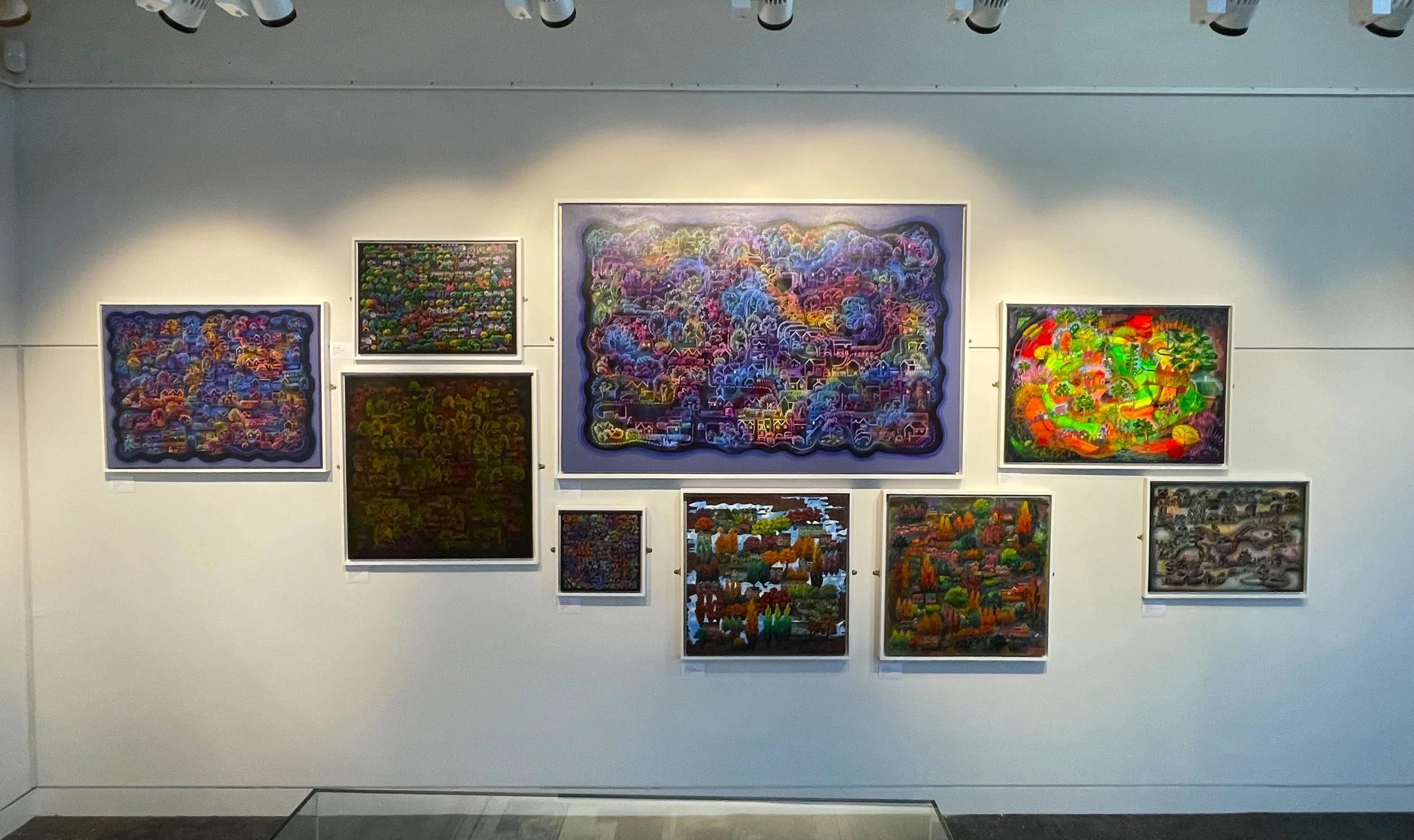
Acrylic on Canvas paintings at Mapping the Familiar Exhibition The Arc Winchester. Photo Mark Jones
The opening is on Saturday 7 February (9.00–16.30), and the work will be up until April. I’m also showing work from the project at Printfest, Ulverston, for those closer to the North.
More soon.
Quick March – From Sketchpad to Limited Edition Linocut Print
Inspiration Behind Quick March
Talking with a neighbour and fellow dog walker first sparked the idea for Quick March. The result is a tale of loyalty, wit, and companionship, captured in a striking limited edition handprinted linocut print.
The artwork brings to life a proud Commander pacing the deck of a battleship, with his faithful terrier Quick scampering close behind. More than just a print, Quick March is a joyful celebration of friendship, storytelling, and the timeless bond between people and their dogs.
From Idea to Sketchpad
Every print begins with a spark. For Quick March, that spark grew through sketches in my A3 portrait sketchpad. When opened, it gives me a spacious A2 canvas, perfect for letting ideas breathe. I fill the pages with thumbnail sketches, notes, and annotations, pushing the idea around until the composition feels alive.
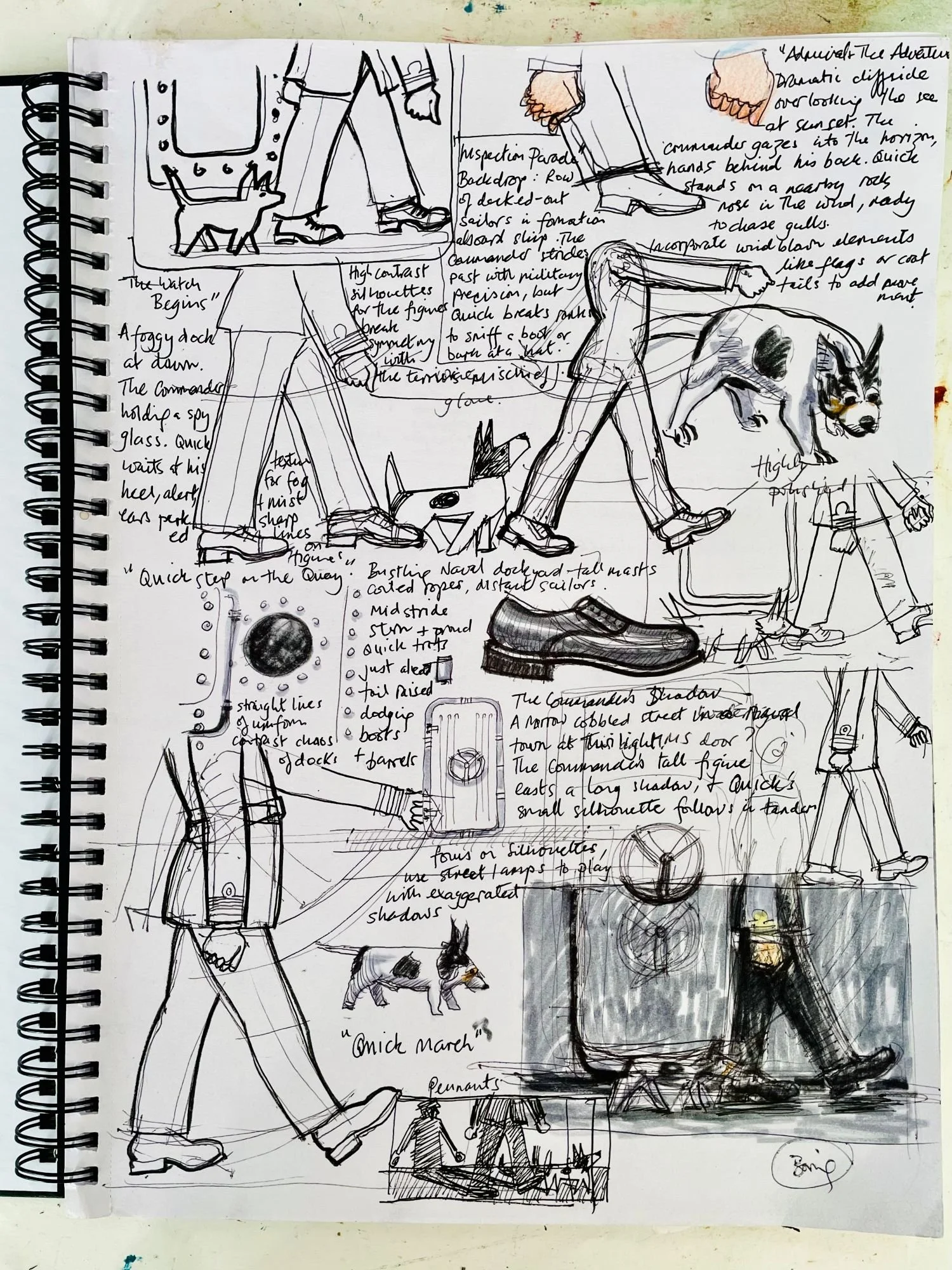
This process is where imagination meets craft - the playful terrier, the confident stride of the Commander, and the suggestion of a ship’s deck all came together here before being carefully transferred into a carved linocut block.
The Linocut Process
Linocut is a traditional printmaking technique that demands patience and precision. Each mark is carved by hand, and every print is hand-inked and pressed. No two are ever identical - small variations in tone and texture make each edition unique.
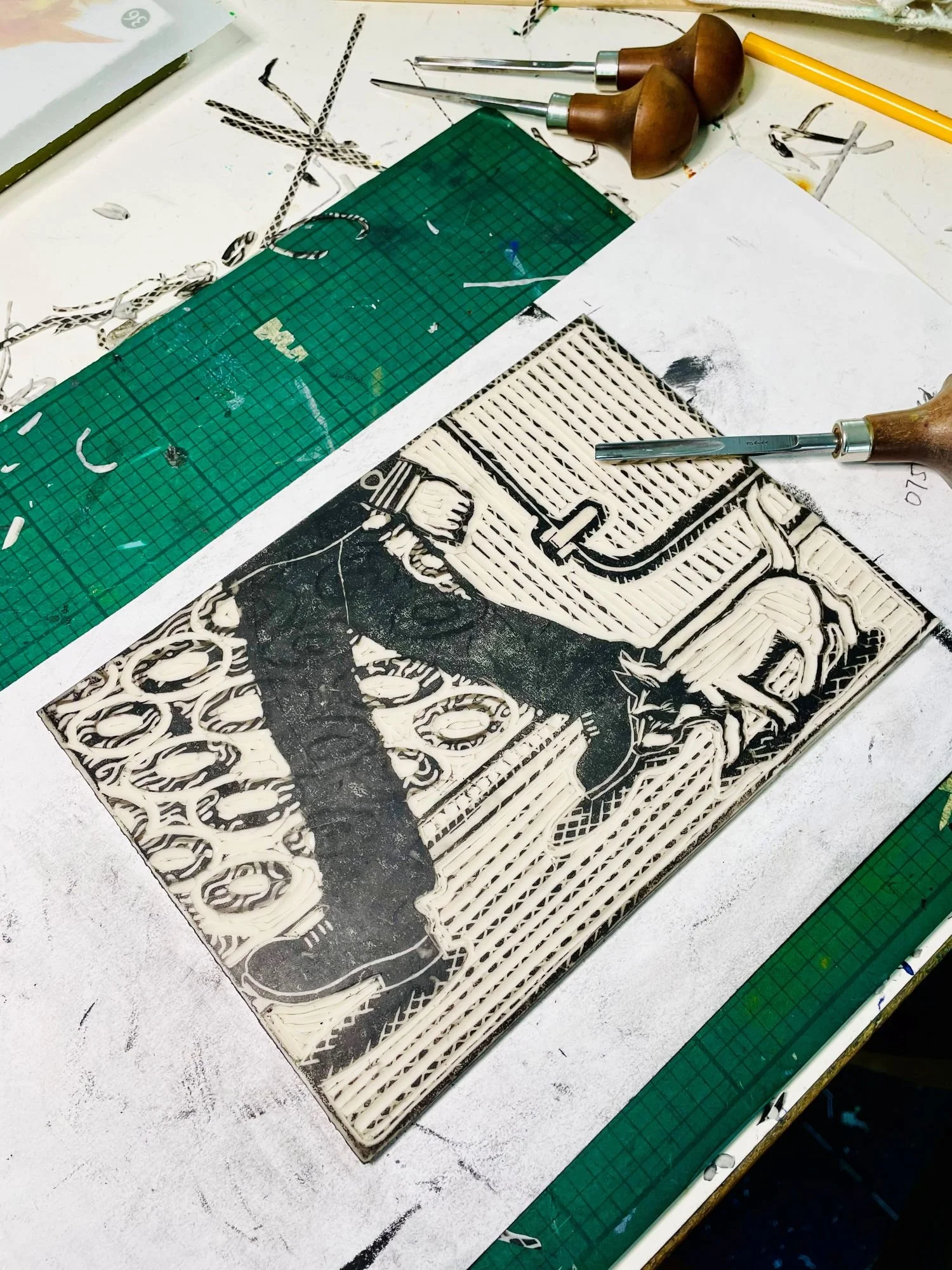
For Quick March, this slow, deliberate process mirrors the story itself: a moment of companionship made timeless through art.
Why Quick March Belongs in Your Collection
This print resonates with dog lovers, naval enthusiasts, and art collectors alike. It’s more than a decorative piece - it’s a narrative artwork that celebrates:
The bond between humans and dogs
The discipline and pride of naval life
The storytelling power of handmade linocut prints
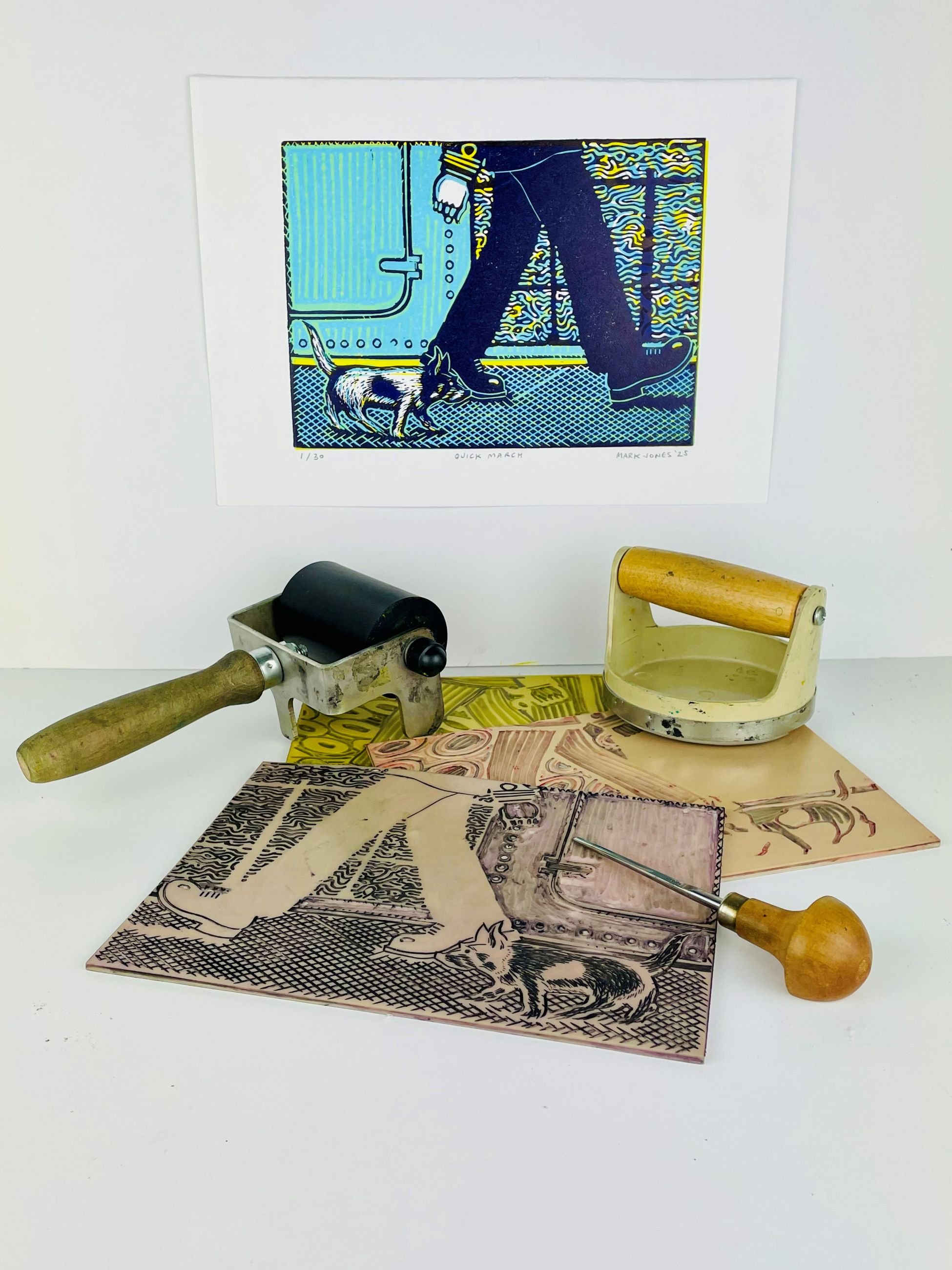
As a limited edition handprinted artwork, Quick March offers exclusivity, making it a thoughtful gift or an investment for collectors of handmade art.
A 20-Metre Community Art Commission in Boorley Green
At 20 meters in length, this is my largest art commission to date—a collaborative public art project created with the residents of Botley and Boorley Green. The piece combines painting and printmaking, celebrating local life through community creativity.

Boorley Green community frieze panels artwork with Sue’s acrylic painting celebrating local community art
Creating the Artwork
My wife, Sue, and I painted 15 plywood panels with a rhythmic, abstract landscape using high-quality acrylic paints. Thanks to the support of Wyvern College, we were able to use their art classrooms during the summer holidays to bring the vision to life.
We’re grateful to local businesses for their generosity:
B&Q, who heavily discounted the plywood
Jackson Art Supplies and Handprinted UK, who provided the paints and inks
Community Printmaking Workshops
To make this a true community artwork, we’ve scheduled six printmaking workshops with local groups, including a summer camp and the Women’s Institute. These sessions invite residents to create images that reflect what they cherish about life in the parish of Botley.

Botley and Boorley Green Women’s Institute printmaking artwork for the community frieze project
So far, contributions include:
Local buildings and landmarks
Animals and birds found in the area
The parish’s unique flora and fauna
Participants are experimenting with foam board and vinyl printing techniques to capture their ideas and memories.

Assorted colourful linocut prints on deli paper for Boorley Green community public art frieze
Celebrating Local Identity Through Art
This commission is more than just a large-scale artwork—it’s a community project that brings people together through creativity. The final piece will stand as a vibrant reflection of Botley and Boorley Green’s identity, heritage, and natural beauty
Leporello book and Wood Engraving
I set myself a challenge a month ago: twelve drawings in twelve days. Thirty days later, I finished them. So what’s the big deal? Nothing except I haven’t drawn for drawing’s sake since teaching life drawing five years ago, and didn’t realise how satisfying the process of drawing from observation is. What to draw? Something local, easily accessible, that I see and pass through regularly, why not the side entrance leading to our back garden? And then include figures and animals to give a sense of scale. Limit the materials, A3 greyboard with pencils, pens, ink washes, and white acrylic paints. As the drawings multiplied in sequence, I joined them with gaffer tape to make one long storyboard without words.

Drawing 12 EC #1 42 × 29.7 cm Pen, ink, pencil and acrylic on greyboard. (Mark Jones 2025)

Concertina prototype book containing twelve digitally reduced prints of drawings of a house and garden. 10 × 7.5 cm (Mark Jones 2025)
Here is a miniature version of the twelve-drawing leporello book. The drawing features don’t always match up at the edges, but that just adds to the handmade quality. I attended a super wood engraving course taught by Robin Mackenzie https://www.robinmackenzie.co.uk/ recently at West Dean College and used one of these pages as inspiration for my wood engraving.

Drawing 12 EC #11 Pen, ink, pencil and acrylic paint on greyboard (Mark Jones 2025)
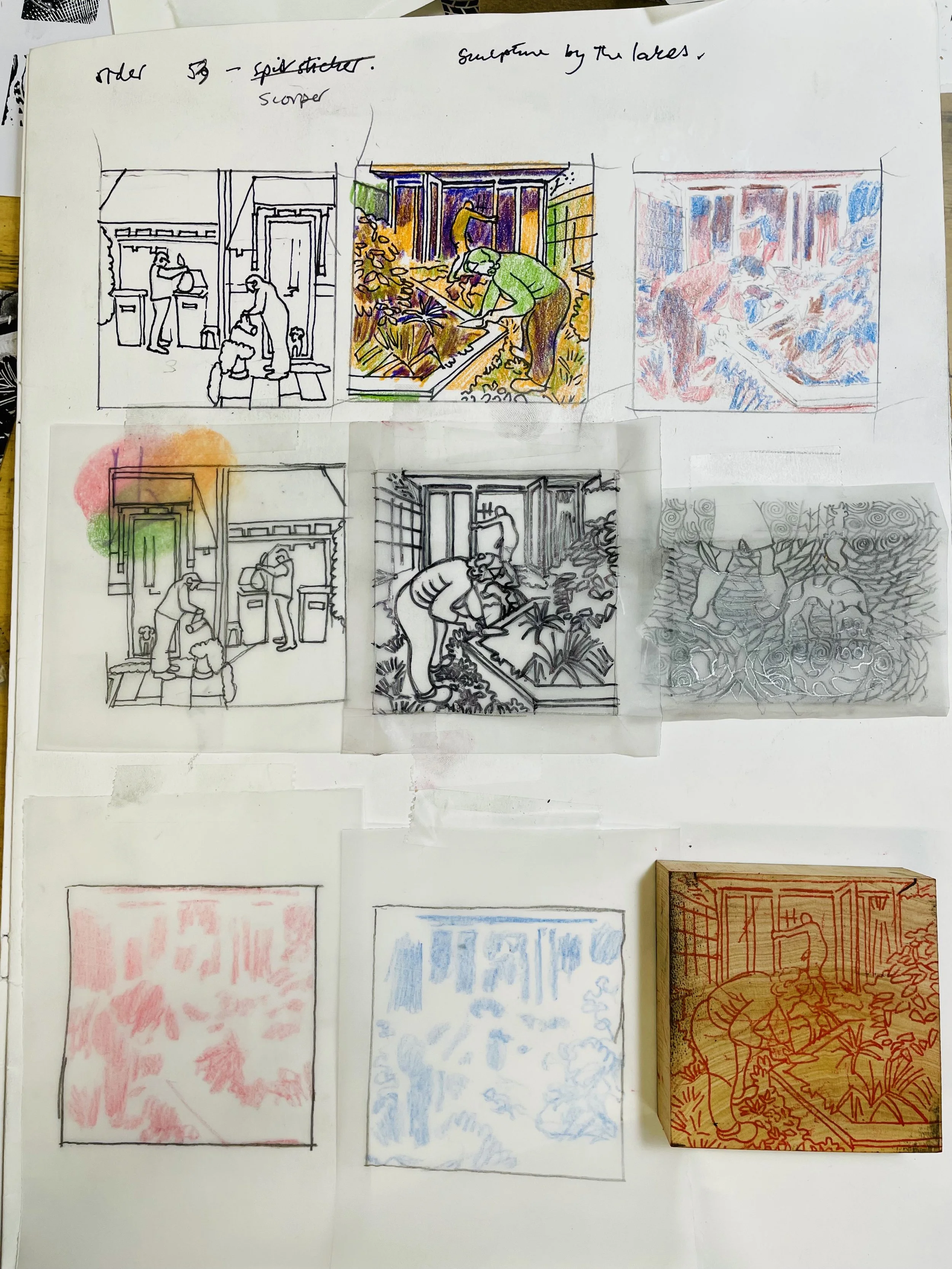
The drawing was reduced traced and carbon copied on to a block of 75 × 75 cm lemonwood. The red carbon line was picked out with a permanent fine marker pen and rolled with black oil based ink which was wiped back to expose the lines. The ink was applied to enable me to see where I have cut the wood.

Wood engraved lemonwood block ready to ink up.

Hand burnished wood engraving on Japanese Hosho paper 40gsm

Having decided on a colour scheme, the key block image was offset printed (transferred using tracing paper printing) onto two linoleum blocks (pink and blue). The linoleum blocks were cut and printed pink first and overlaid with blue to obtain tertiary colours, before the final black key block was printed on top.

12 EC #11 Wood engraving in three colours (black, pink and blue) on Hosho paper. 7.5 × 7.5 cm (Mark Jones 2025)
What’s next? Well, I am preparing for the next Winchester Print Fair by making new prints based on drawings of walking in Stoke Wood Park. The intention is to produce a suite of prints that can be combined in a leporello book.

MA Illustration Degree
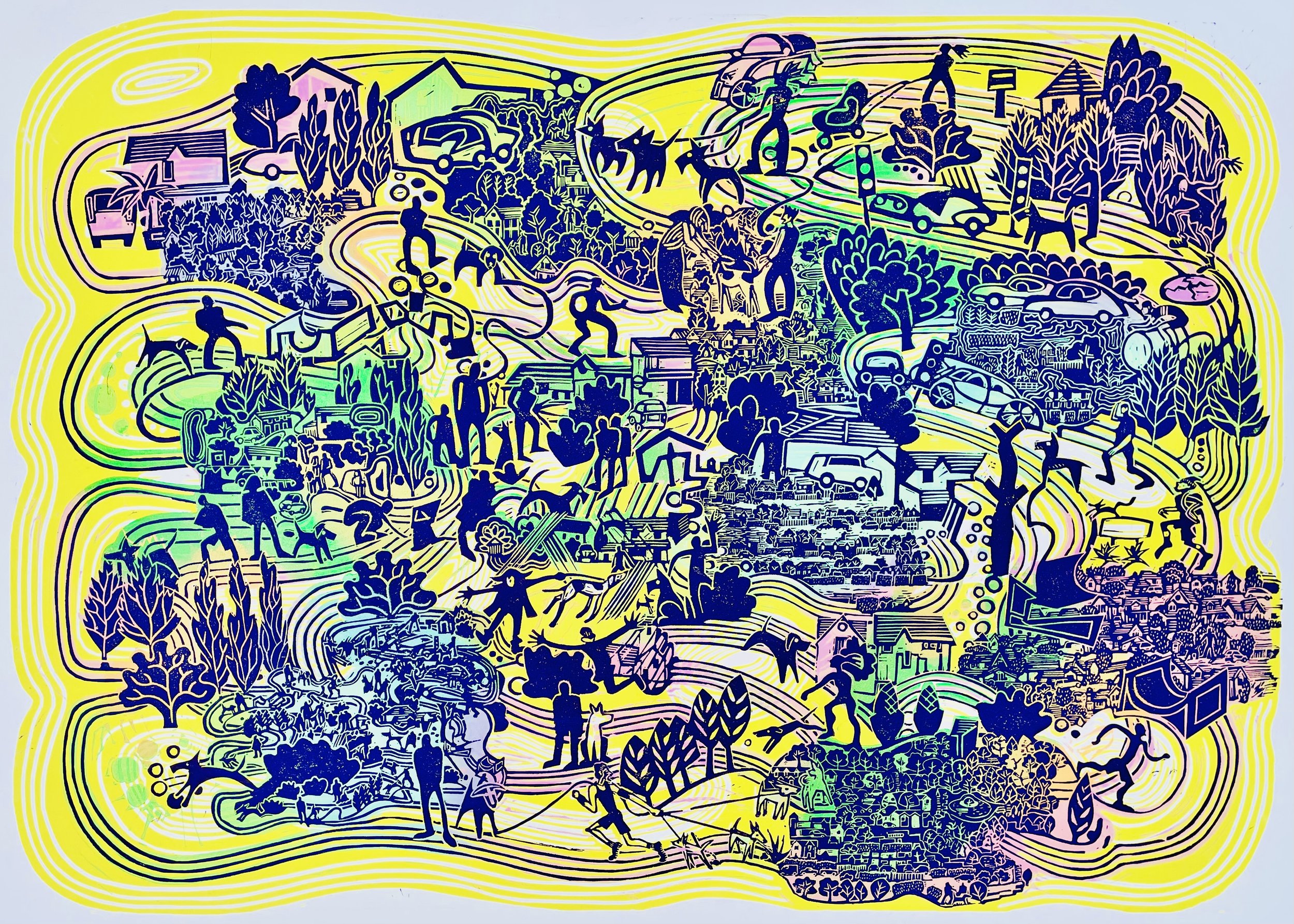
Hounds of the Heath 4. Linocut in three blocks with local colour added freehand on the second block. 76 × 56 cm 2024
I embarked on an MA Illustration Degree course part time at the University of Portsmouth in September 2022 and have now completed it. with Distinction. It has been a fantastic experience that certainly challenged me to understand new concepts, philosophies, ways of seeing and producing. A practice based course, students meet once a week to attend tutorials, seminars, presentations and workshops. We accessed the extensive facilities and staff expertise during the rest of the week. During the two years, I constantly reviewed and refined, my research, project proposal, illustration in context and major project modules.
The linocut print Hounds of the Heath 4 is the latest piece in a series inspired by dog walking and Ordnance Survey maps, the print marked a culmination of the MA course and combines scaled down versions of previous prints with larger images of characters and incidents witnessed.

Hounds of the Heath 4 detail.

Hound of the Heath 4 detail
My MA Illustration proposal stated that I would make a series of twelve hand made prints on the theme of human canine companionship and connection. These linocut prints are published on my website.
The Grosvenor School

Claude Flight Speed c.1922
4 blocks edition of 50. 22.6 x 28.8 cm
Off white Japanese paper. 1st layer Yellow ochre. 2nd Cobalt blue. 3rd Vermilion. 4th Prussian blue.
I have been influenced by the work of the Grosvenor School artists. In particular, their simplification and stylisation when recording movement in everyday scenes and the limited use of three or four overlapping colours to create additional hues.
This print is unusual because it’s printed on the reverse side and Flight would often mount prints on yellow inked paper backing and sometimes dark toned paper, to modulate the image tonally.
A print by its handmade method of production can have 'patches of bald areas' and modulation of intensity and tone can be achieved with hand burnishing.
Claude Flight taught linocut at the Grosvenor School of Modern Art from 1926 - 30 and his methods were a big influence on his students. Most of the Grosvenor School linocut printmakers used three or four blocks, rarely reduction printing. Renowned for their application of movement and vibrant colours, they responded to Futurist Marinetti's call for art to reflect modern (1920’s) society, in a very direct way. They favoured using thin (tissue) Japanese papers which are robust.
Flight often did not date his prints, because artists would print in batches depending on popularity, in a print on demand arrangement. The Futurists used multiple viewpoints and interpenetrating planes to convey busy movement. Flight used curvilinear distortion and cropped images to suggest movement.

Cyril E Power The Sunshine Roof. c 1934 Linocut
4 block: 1. Cream, 2. Orange, 3. Mid green, 4. Dark green in that order.
Linocut has been seen as a rather lowly crude and simplistic art form, exploited by the German Expressionists: Erich Heckel and Christian Rohlfs. In the UK Horace Brodzky and Gaudier Brzeska, (Wrestlers 1914). But for Claude Flight it was a 'modern medium for a modern age,' linocut was expressive of the 'speed and dynamism' advocated by the Italian Futurists.

Cyril E Power, Folk Dance Linocut 1932
22 x 24.6 cm
4 block: 1. Peach, 2. Red, 3. Dark grey, 4. Black. On off-white Japanese paper.
The print does not contain solid blocks of opaque colour, there are subtle colour patches where previous colour layers show through top layers. Transparency can be achieved by adding extender.
Flight instructed to use equal amounts of detail on each block and to ignore the old guideline of the first block being a dark outline with subsequent layers being the colour infills.
Key exponents of linocut were: Sybil Andrews, Dorrit Black, Ethel Spowers, Claude Flight, Cyril Power, Lill Tschudi, Edith Lawrence. There were lots of other students who achieved recognition from Claude Flights teaching.

Sybil Andrews, The Winch, 1930
3 blocks 1. Chinese Orange. 2. Veridian. 3 Dk Blue
18.4 x 28.4 cm Edition of 50.
Most of the Grosvenor School printmakers made editions of 50 or 60 but printed them in batches on demand. What is evident from these examples is that the ink was transparent, to create addtional colours and tones where overlap occurs. Extender medium is added to the colour ink to create transparency, I add wax driers to speed the drying process, and will impatiently print wet on wet to see the outcome quickly.
As I have become more familiar with the process of making linocut prints I have adopted Claude Flights print on demand approach to producing editions. I publish test pieces online to establish whether they are worth editioning and then depending on popularity produce batches of up to 10, for an edition of 30 to 100.
Bibliography
Carey F. & Griffiths A. Avant-Garde British Printmaking 1914 - 1960 BMP 1990
Leaper H. Sybil Andrews and the Grosvenor School Linocuts. Osborne Samuel 2015
Ackley C. S. British Prints from the Machine Age. Rhythms of Modern Life 1914 - 1939. Thames and Hudson 2008
Etching process

Wake Up Call. Etching 21 x 29.7 cm Mark H Jones 2024
The proposal for my MA Degree major project included experimenting with etching using hard and soft grounds, a process perhaps sympathetic to my drawing style. Jordan Baines instructed me on the etching process which involves preparing a zinc plate by degreasing and applying a hard ground to the surface. Using a scribe or in my case a ‘dremel’ I drew through the ground. Once the scribing is complete, the back of the plate is covered with a sticky film to protect it. The plate is submerged in mild acid for between five to twenty minutes; the acid attacks the bare metal to leave a groove. The plate is rinsed and then cleaned with Lincoln wash, the sticky backing film removed and the edges of the metal plate chamfered with a file and burnisher. The etched metal is warmed on a hot plate and intaglio ink spread around the metal sheet with a card. Wiping back is a crucial skill ensuring sufficient surface ink is removed whilst enough is left to provide varied tone or chiaroscuro, this takes a lot of practice. Meanwhile the paper (Cartridge, Tracing, Kent or ‘bread and butter) is soaked for at least ten minutes, drained off and dried between blotting paper.
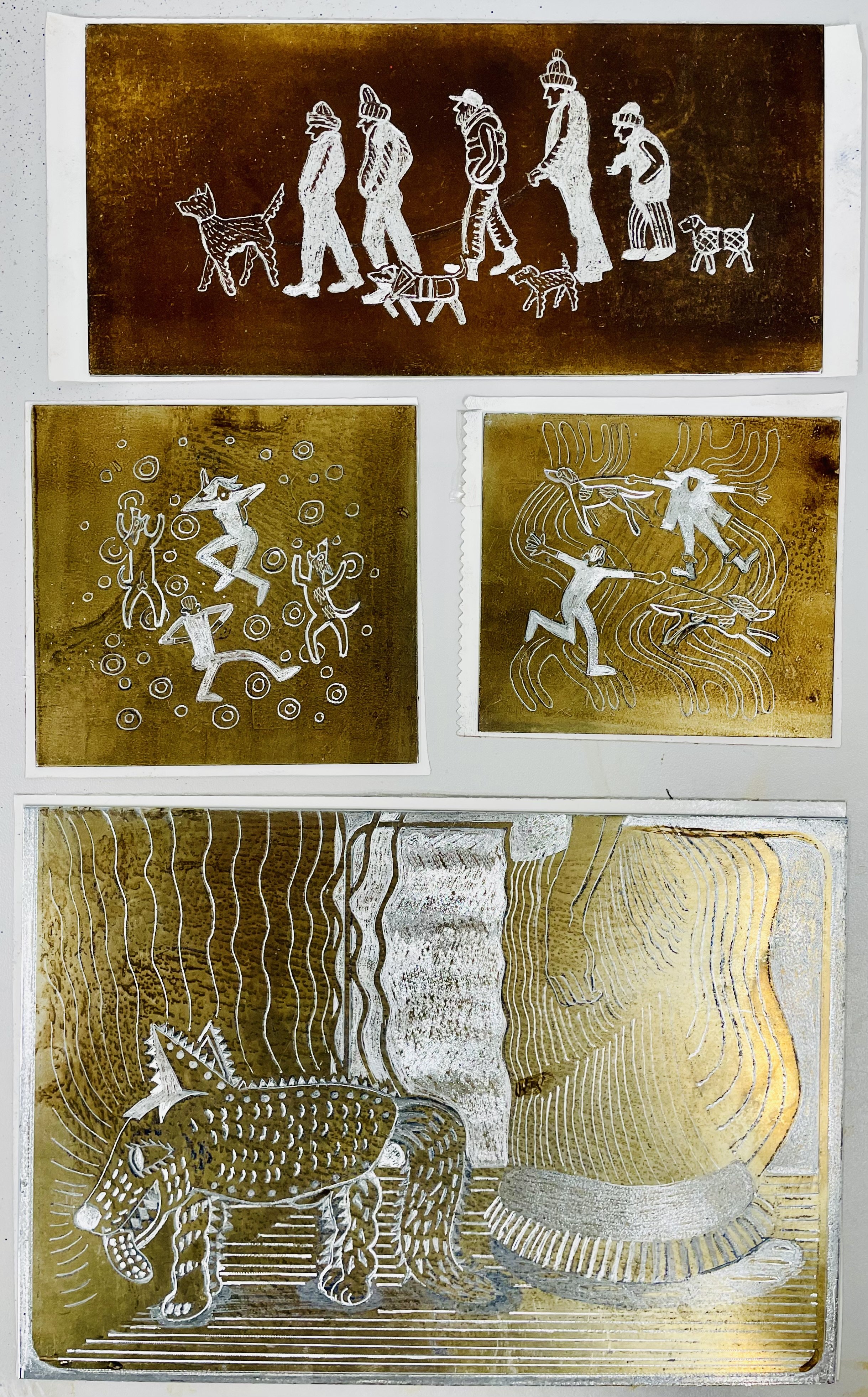
Lines drawn using a ‘dremel’ into hard ground. (Mark H Jones 2024)

Hard ground on a zinc plate in the acid bath. (Mark H Jones 2024)

Etched plate cleaned with Lincoln wash and chamfered. (Mark H Jones 2024)
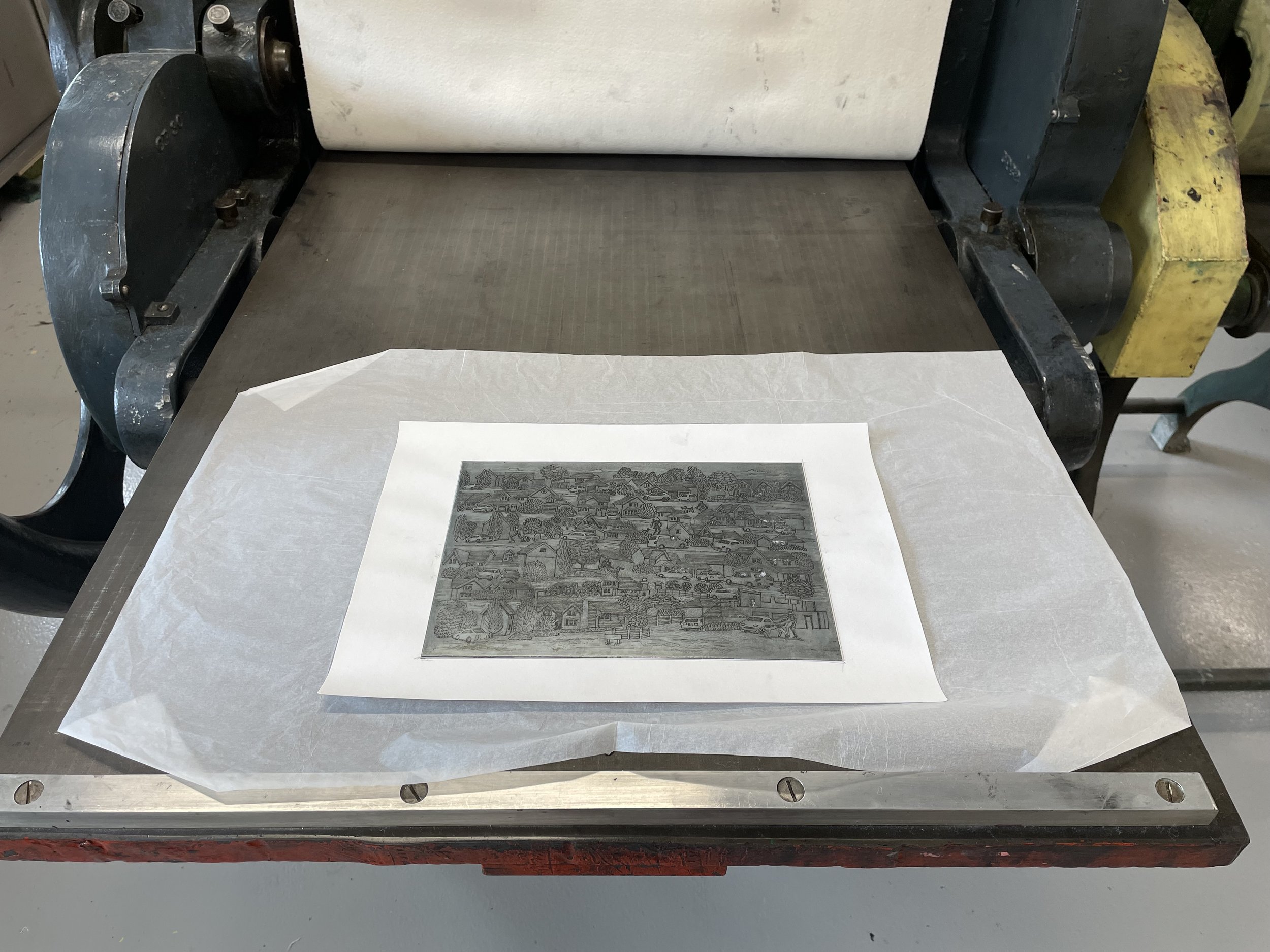
Printing with an Etching Press UoP Printmaking. (Mark Howard Jones 2024)
Inked etching plate on etching press bed before the damp paper is placed on top with another a layer of tissue pape addedr to protect the blanket. (Mark H Jones 2024)

Attempts to ink the plate and wipe back, in some cases overdone. (Mark H Jones 2024)
The damp paper draws the ink out of the etched lines when compressed in an etching press.
To get a decent print, the paper should be damp, I was blotting and drying it too much, and that meant the paper stuck to the plate. I also removed too much ink until I realised much could be done modulating the tone by selectively wiping areas of ink away, this is known as 'plate tone'. Some of my designs have relied purely on line and lack tonal variation, so when creating an image to etch it is useful to know how the process works, I have been doing this by trial and error and now appreciate how skillful etching is.
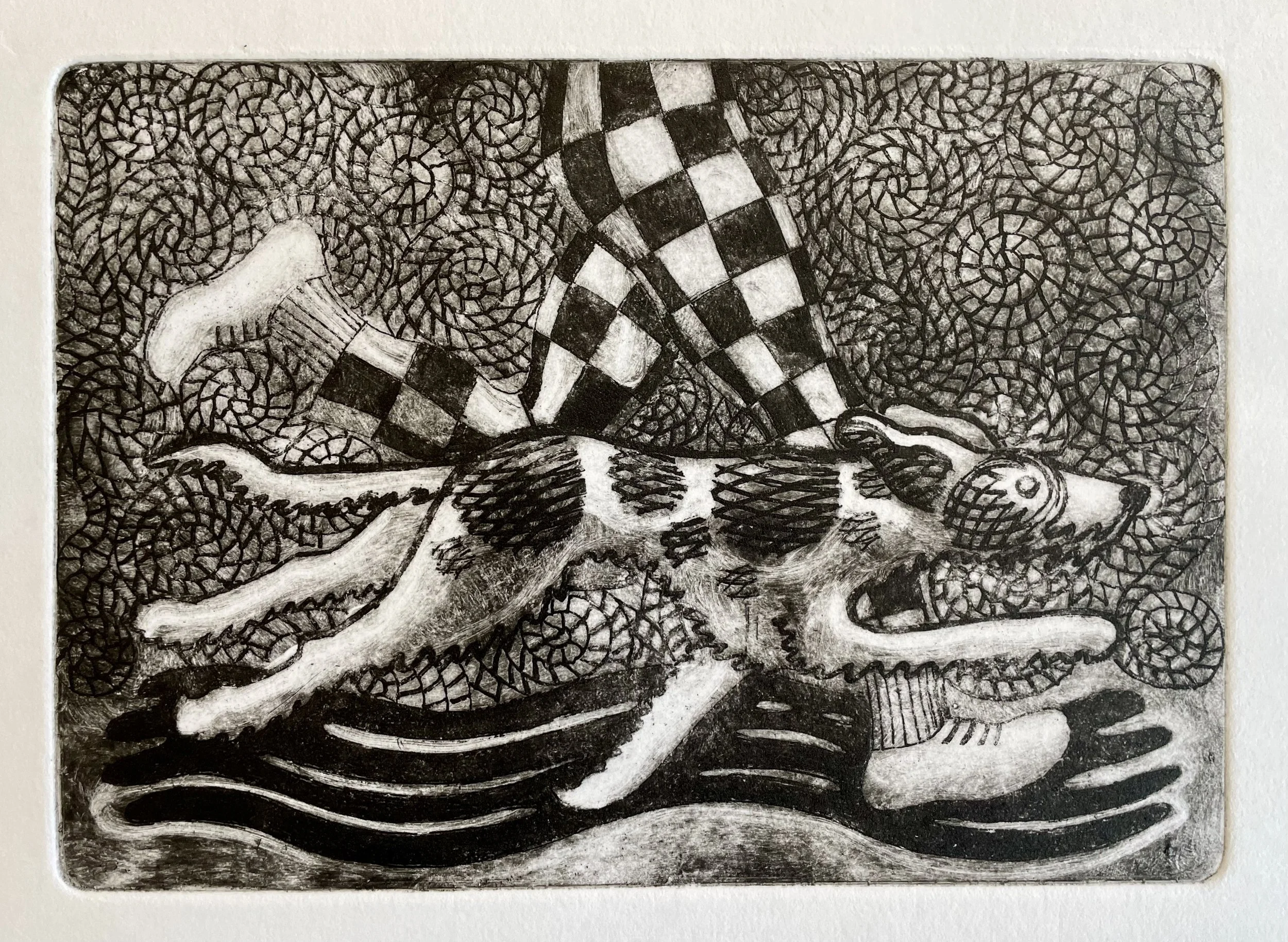
Let Loose. Etching 15 × 21 cm Mark H Jones 2024
I continue to call upon Jordan’s expertise and he has recently reviewed my efforts, providing suggestions on how to improve, I list my practical experiments regularly on social media: https://www.instagram.com/mark.jones.art/reels/
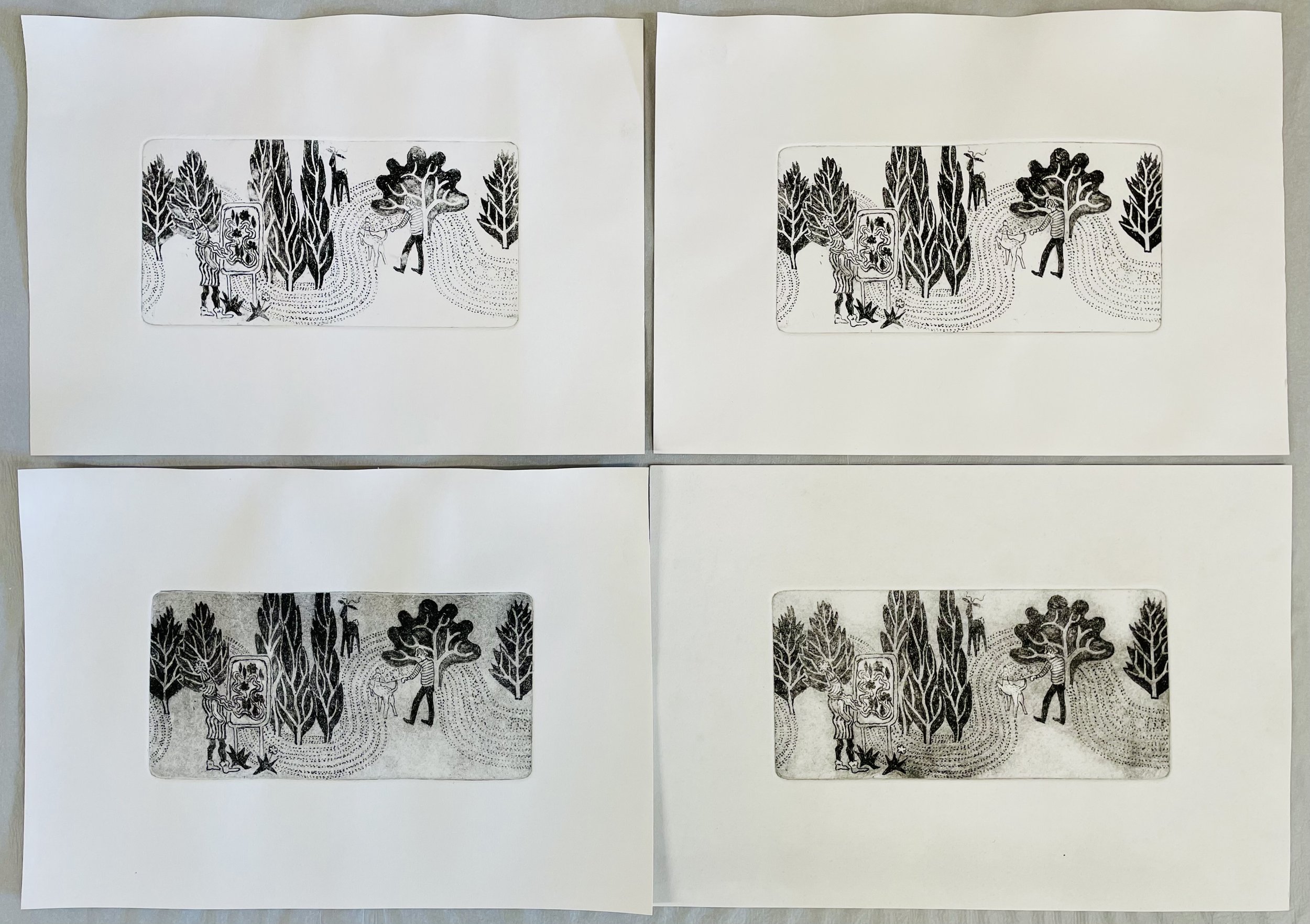
Park Map 7.5 × 15 cm Etching Mark H Jones 2024
Ros Simms gave tutorial feedback on my portfolio of etchings and explained how best to register multiple plates, along with the importance of using tissue paper to clean the plate without dislodging the ink where needed. She showed me fantastic examples of etching and mezzotint and I realise my efforts fell way short, I think I could have saved time and effort by asking for more direct instruction. The etching process has been fascinating and frustrating in equal measure. I look forward to persevering with this fascinating process.
Winchester Christmas Print Fair 2024


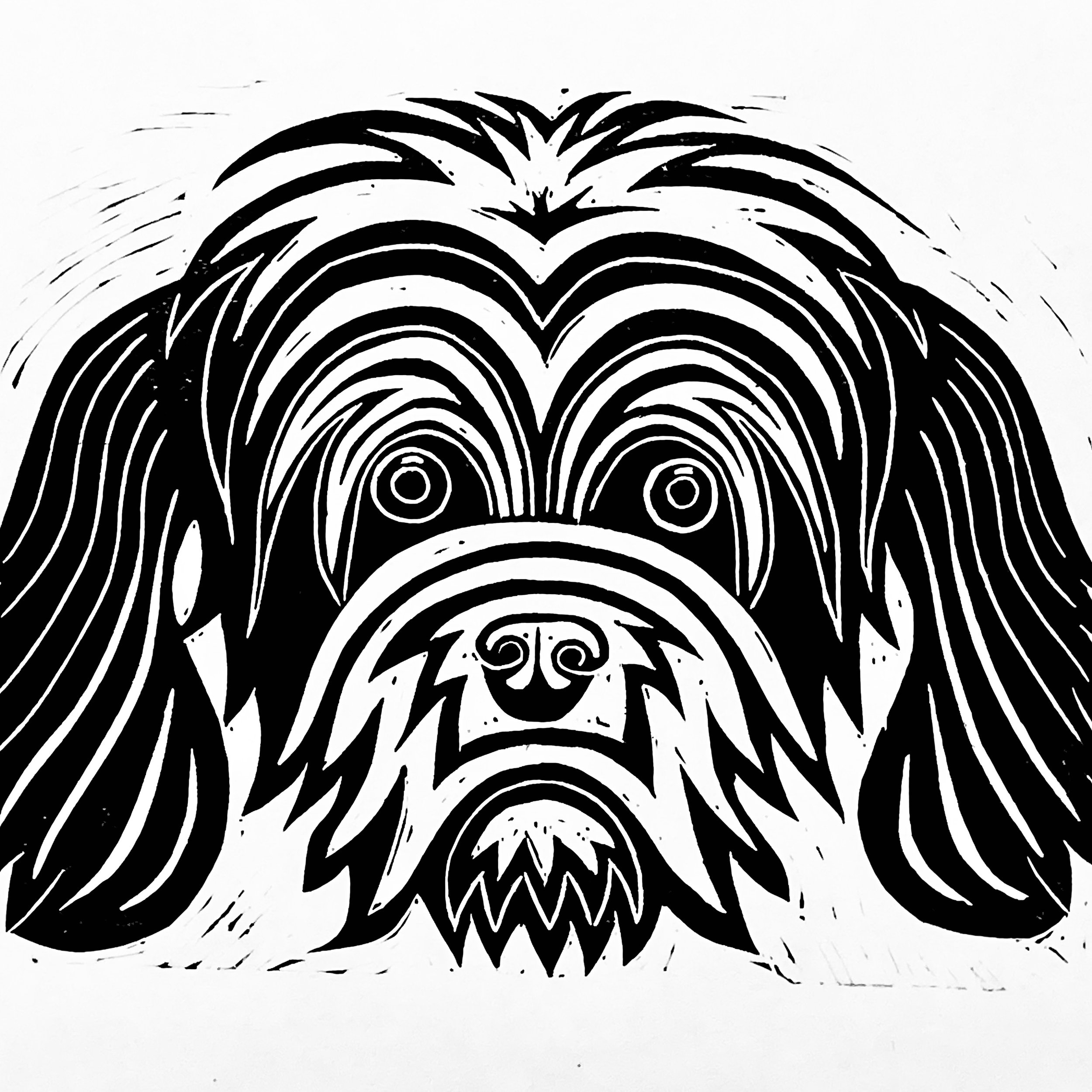
I really enjoy participating in the Winchester Print Fair, it’s a great opportunity to catch up with fellow printmakers and the atmosphere is always buzzing. I like to plan the display beforehand and treat it as a giant collage exercise. I’ve made a tall lightweight stand, that catches the eye from a distance and maximises the table top space. For my seventh print fair, I’ve produced some new themes; ‘companionship’ and ‘tasty morsels’, to add to the existing ‘landscape/maps’. I note conversations with stallholders, visitors and customers, it helps to review the display and record ideas for new work. In terms of the display design I have always composed in rows, but next time the format will be totem pole columns. I feel a visit to either Pitt Rivers or the British Museum coming on. New ideas include producing colour versions of recent work and having a display solely of colour prints..
The Morning Walk video
The Morning Walk
I spend so much time walking with my dog 'Bruce', so I decided to film our morning walk from his perspective, using a 'GoPro' video camera attached to his harness. The titles refer to invented names for parts of our suburban, some are self explanatory others more obscure: the Avenue; a line of elm trees, Crabapple mash; a tree whose apples get trodden on, The Judd; a severely trimmed hip high square hedge - reminiscent of a Donald Judd Minimalist sculpture. By naming these ordinary non descript features the walk takes on more significance, our dog is eight years old and we have walked this route most mornings - so its a well trodden path, which I can easily visualise in my mind. Because Bruce will often stop, I am forced to slow down and notice and appreciate our surroundings and I usually feel calm and relaxed during our stroll. Occassionally there are incidents, sparked by Bruce's reaction to squirrels, deer and some other dogs when the tranquil mood is disturbed as he pulls on the lead, I dare not let him off because he loves to chase. The walk last for twenty minutes but its been edited down to three to capture the gist of it.
Society of Graphic Fine Art 2024


Delighted that the Cut Loose linocut print was accepted at the Society of Graphic Fine Arts 2024 show organised by The Drawing Society at the Mall Galleries.

Artwork description:
A linocut print of a dog and a person wearing orange shoes and tweed trousers, selected for the Atelier beside the Sea, Brighton Open 2023 and SFGA Mall Galleries 2024.
A humorous artwork about going out into the warm air.
‘Every week at work we had a bonus ball lottery and I won. With the winnings I bought a rescue dog from St. Francis Animal Welfare, Fair Oak called Bruce. When I retired from teaching I made this linocut print to celebrate moving on and as gifts for my colleagues. The artwork's colour and texture symbolise my mixed emotions about being on the threshold of leaving and Bruce is pointing the way out, it's simultaneously a happy and sad feeling.’
Royal Society of British Artists 2024

Night Walk, linocut print on 300gsm Snowden paper Edition of 20 59.4 x 42 cm 2021
Event: The Royal British Society of Artists
Dates: Feb. 29, 2024 - March 9, 2024
Venue: Mall Galleries, London
Annual Exhibition
Artwork description
A detailed nighttime suburban landscape linocut print conceived during lockdown, it is one of my early linocuts from 2021. Our dog 'Bruce' never gets bored of walking our local streets day or night and neither do I, there is always something to catch the attention if you look closely. I had fun making the windows the highlights, and varying the marks for the sky, the roof’s and the foliage, all the wheel hubs and headlights were made by twiddling a fine drill bit.

‘Night Walk’ linocut print Artists Proof, paper size 59 x 42 cm, edition of 20, Mark Howard Jones 2021
Linocut demonstration at Bankside Gallery
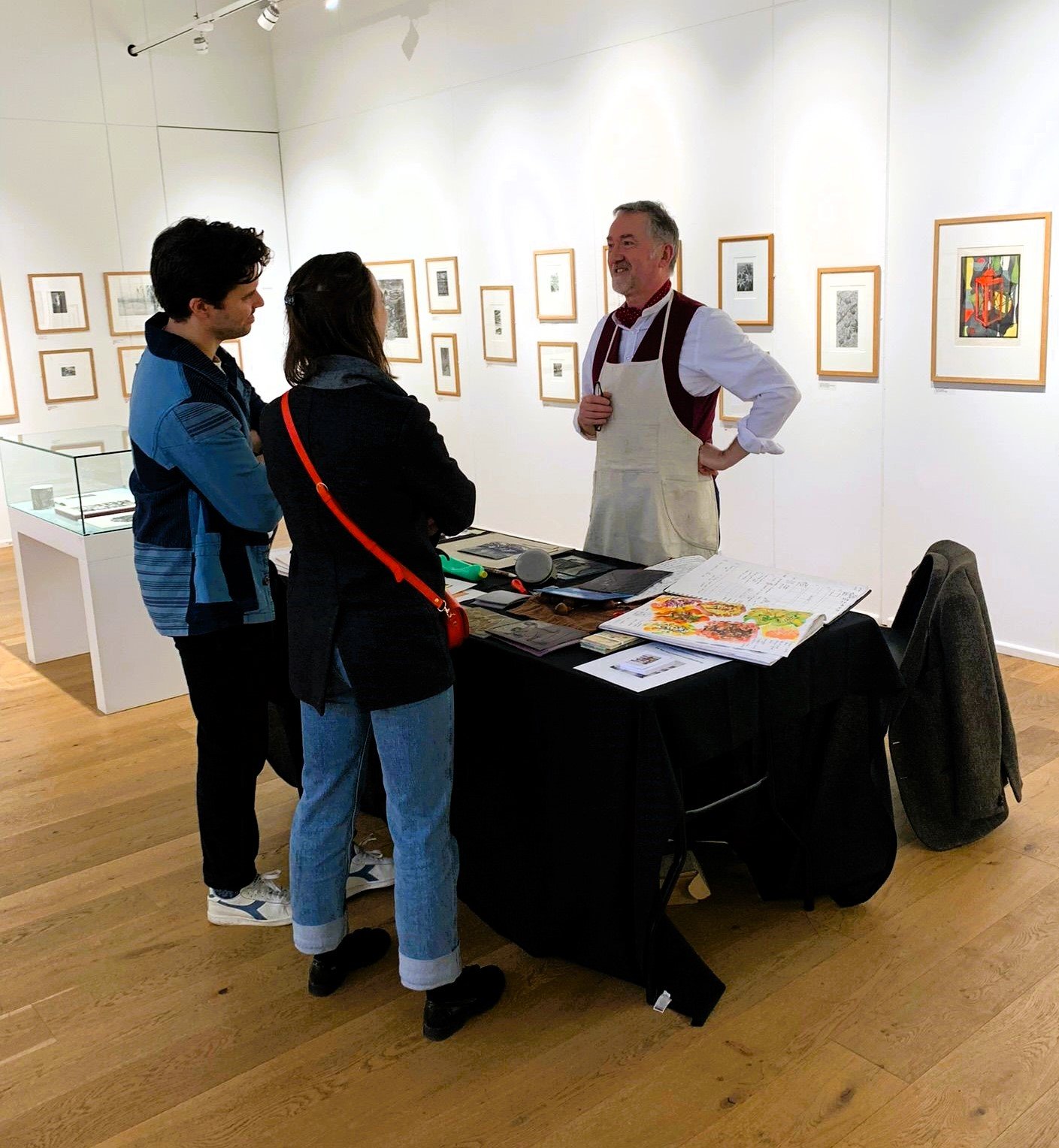
Bankside Gallery, London 17th February 2024
Bankside Gallery linocut demonstration
I like wearing the printmakers apron, it puts me in production mode! I spent more time talking with gallery goers than printmaking, and thats how it should be, I was there to answer questions and offer suggestions, visitors prefer not to disturb you if your busy cutting or printing.

‘Let Loose’ detail linocut print, this dog appears in a larger print I am currently working on.
Tools of the trade
I print with Caligo Safe Wash inks, often using extender to stretch the ink further and also to make the layers of colour more transparent and a small dab of wax drier to speed up the process. The powder in the pot is talc, which I use to blot out ink that I don’t want on the linocut block. The wooden handle is a large clay modelling tool, ideal for focussed burnishing on the back of the paper when printing.
Society of Wood Engravers 86th Annual Exhibition 2024
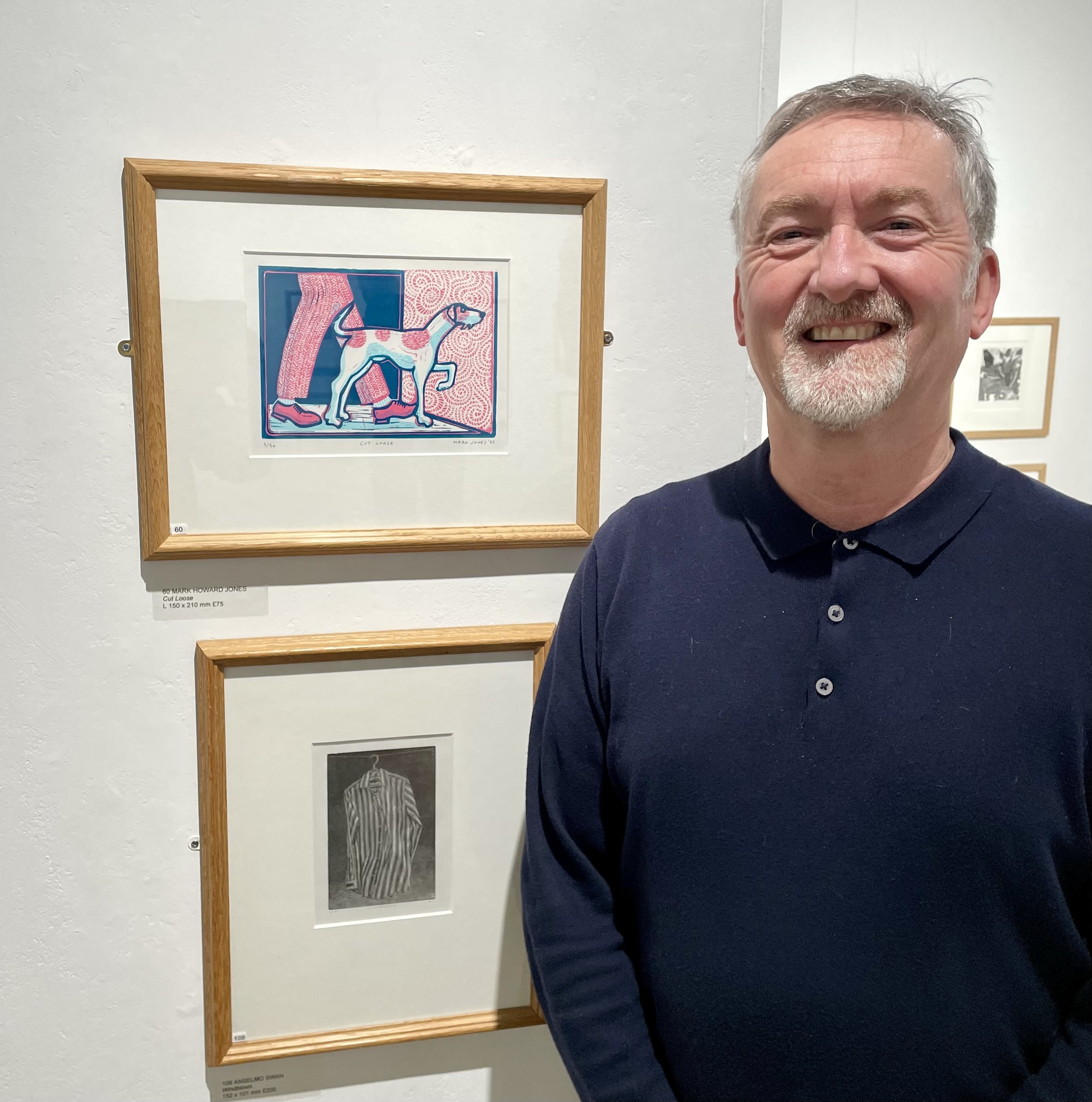
Bankside Gallery, London 6 - 25th February 2024
Cheesy grin please
'Cut Loose' process
I have had lots of practice hand printing this image in a variety of colour combinations, and the design continues to evolve. Jo Morley of Omega Printmakers Portsmouth had suggested I needed some texture in the original design so I ended up cutting three blocks of lino. The swirling pattern whilst looking like wall paper is intended to represent a ‘blustery’ atmosphere, I’ve always admired Leonardo Da Vinci’s waterfall drawing and its influence is evident. Whilst cutting these blocks I never know how much ‘chatter’ to remove, as they provide printed evidence of the handmade process and can suggest movement if going in the right direction.

‘Cut Loose’ linocut print, image size 21 x 15cm, edition of 30, Mark Howard Jones 2023
Bonus Ball Bruce
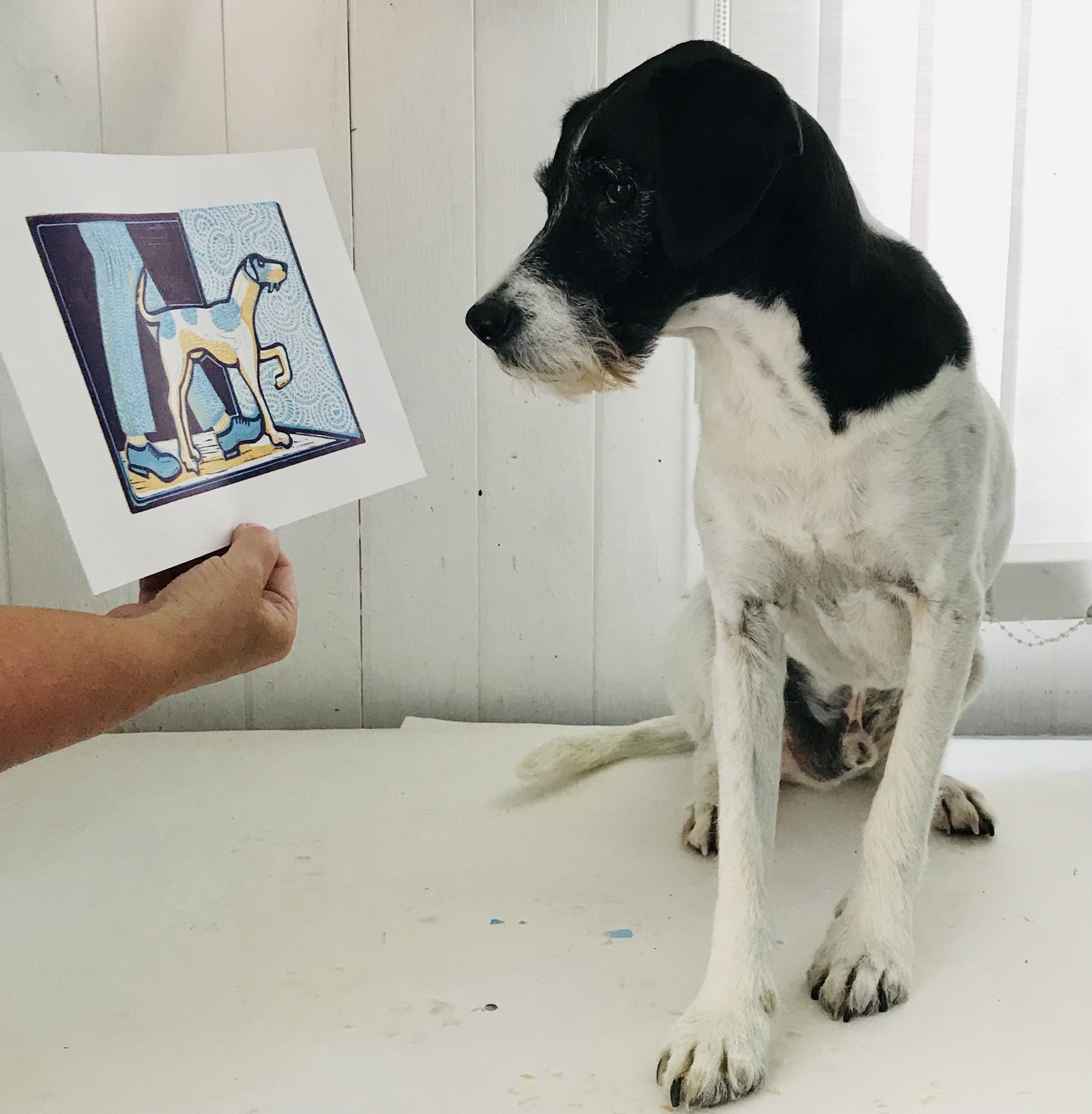
This is you Bruce in blue.
Some background information about Bruce and the artwork 'Cut Loose'.
Bruce was 6 months old when arrived at St Francis Animal Welfare in Christmas 2015/16. He's a black and white spaniel/terrier cross (6/6/2015), very lively and too much for his previous owner who wasn't well.
I took him for a walk during an open day in January 2016, returned him and waiting at the gate was young family who said 'mummy, mummy can we have that one'. On impulse I said 'sorry he's sold'. (I felt really awful to disappoint them), Vicky was rather surprised because in five years of volunteer walking I had never expressed an interest to buy.
I bought him with bonus ball winnings and told my art department colleagues at Peter Symonds College, Winchester I had invested their money in Bruce.
When I retired from teaching, I gave my colleagues 'Cut Loose' linocut prints as farewell gifts, inspired by the theme of moving on to pastures new with mixed emotions, both happy and sad. Every year I used take Symonds A level Art students to the Royal Academy Summer Exhibition and I have been submitting artwork without success until this year, when they accepted my 'Cut Loose' linocut print.

‘Cut Loose’ linocut print, image size 21 x 15cm, edition of 100, Mark Howard Jones 2023